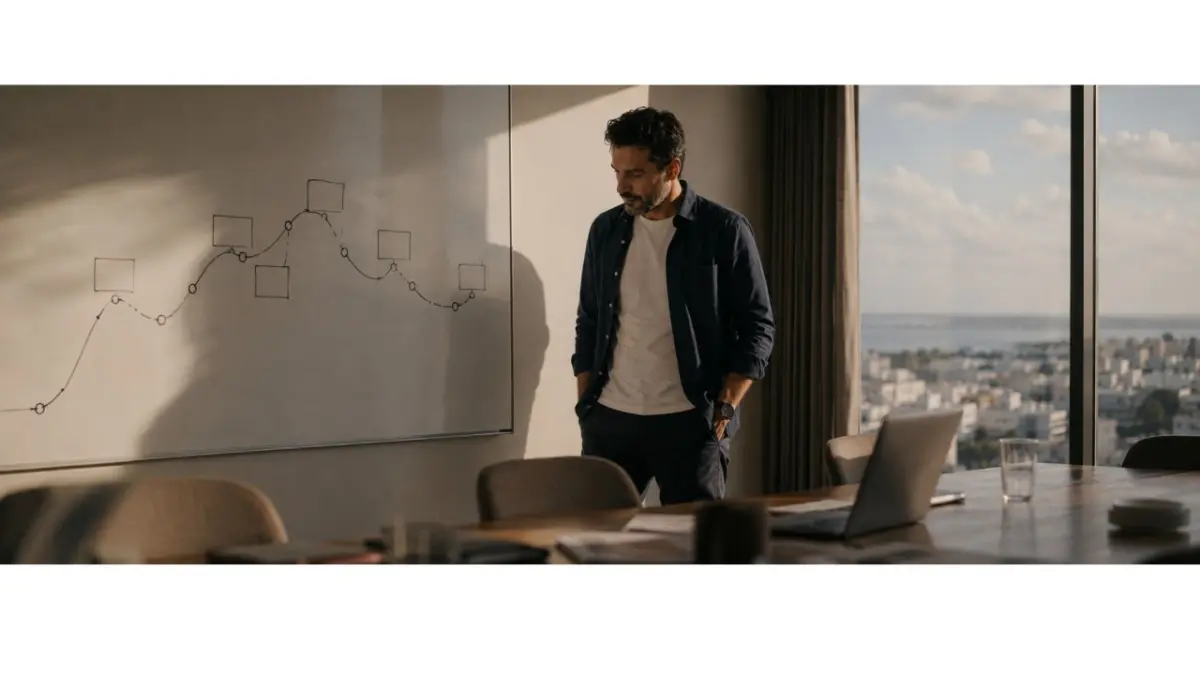
By the end of the week, the separate observations had formed one clear picture. The whiteboard no longer showed two competing routes — one for portals and one for agents. In their place was a connected buyer infrastructure in which every channel had a defined role and passed interest to the next part of the journey.
Andreas brought the team together for an audit rather than another performance presentation. He wanted to know what the company would retain once an advertising campaign ended: only impressions and contact details, or also a stronger route, useful first-party data and a clearer understanding of demand. He wrote one line at the top of the board: “Visibility without control becomes expensive.”
No one read it as an argument against reach. The point was simpler: visibility works harder when the attention it creates can continue through a system the developer understands and manages.
What the Company Is Really Paying For
The cost of dependence was not limited to listing fees. When every new group of buyers entered and continued its journey almost entirely within an external environment, the developer repeatedly paid for access to attention without strengthening its own infrastructure. A campaign could generate enquiries while contributing very little to the next campaign’s data, website experience or sales process.
— We’re not reducing external reach just to push everyone onto our website, — Andreas told the team. — We’re making sure every useful channel has a clear next step. That way, the portal, agent, website and CRM operate as one joined-up system rather than four separate touchpoints.
In that system, portals handled discovery and agents added personal recommendations and buyer context. MLS RealtyHub maintained live inventory, IDX or API feeds delivered it to the website, and enquiries entered the CRM with the information needed for follow-up. The company could continue using external reach while managing the route that followed.
Four Questions for the Audit
Four questions appeared on the screen. Where can buyers see current inventory? Who controls the route after the first click? What first-party data does the developer receive? Can an enquiry be connected to its channel, project and specific point of interest?
The team could now answer the first question: current units needed to appear not only in internal files, but also on the developer’s website. The second question checked whether buyers received a clear next step after discovery. The third and fourth connected marketing with sales, ensuring that an enquiry arrived with both its source and its context intact.
These questions did not divide channels into good and bad. They showed what role each source played and what happened to buyer interest after the first contact. Channel performance could therefore be assessed by both traffic volume and the quality of the route built around it.
Why More Reach Is Not Always Better Reach
As the meeting ended, Andreas remained by the whiteboard. Solving one problem had revealed the next: if the company added more platforms and created more points of contact, would distribution automatically become stronger? More reach on its own could not answer that question.
One channel might bring a large audience at the beginning of the search. Another might deliver fewer enquiries but add a personal recommendation, a confirmed budget and specific buyer requirements. A third might help someone return to the project and inspect live inventory, meaning that the same number of clicks could represent very different levels of intent and conversion context.
The next challenge was not to appear in every available channel simply for the sake of being everywhere. It was to create a balanced channel mix and understand what each source contributed. The team needed to identify which channels generated discovery, which built trust, which carried useful data and which best supported the move towards an enquiry.
A System That Keeps Learning
The week had begun with two charts and ended with a different way of evaluating growth. Visibility was now considered alongside route, data, attribution and follow-up. Attention still mattered, but it was no longer expected to tell the entire story on its own.
Andreas erased the old diagram in which each channel ended with its own separate arrow. In its place, he drew one connected route: external discovery, live inventory, the developer’s website, an enquiry and the CRM. The infrastructure did not replace portals or agents; it connected their contribution to a system the developer could continue improving.
The week’s conclusion fit into a single sentence: external reach helps buyers find a project, while owned infrastructure helps the developer carry that interest forward. The team now had its next question to answer — which combination of channels would bring not just more people, but more of the right people?
Author
This material was written by Maria Vashchenko.
For questions, collaboration, or further discussion, feel free to contact me on LinkedIn.