Databases for Managing Real Estate Information
A structured database connects properties with working records and keeps information current across the team.
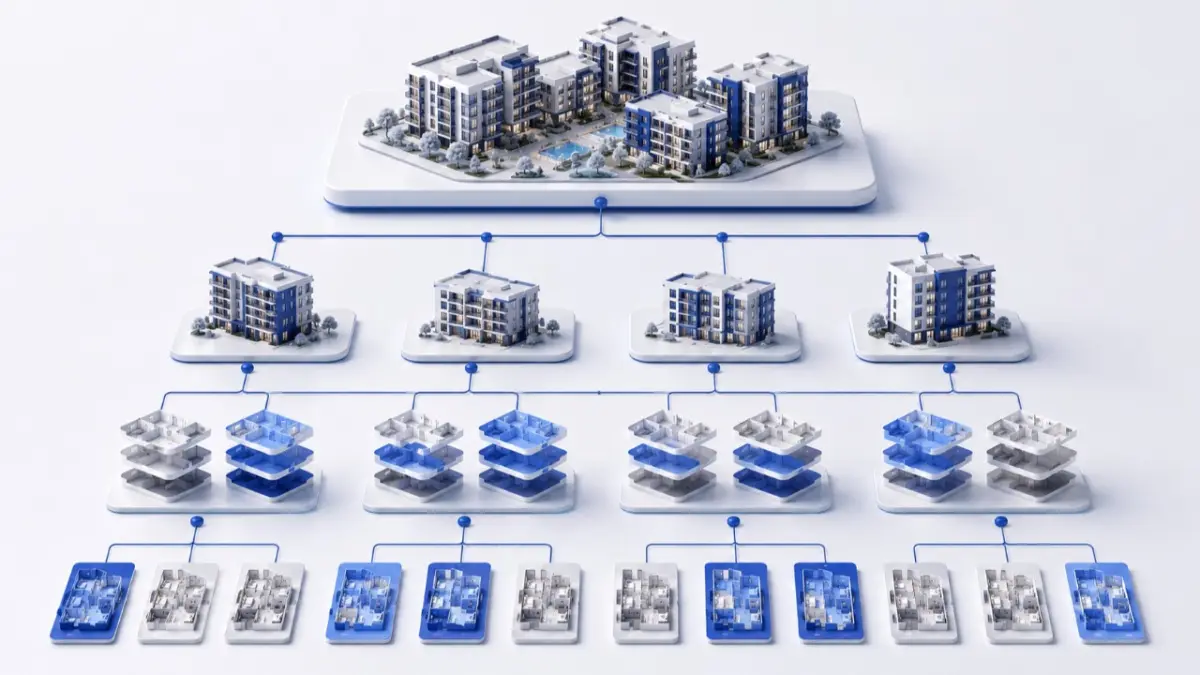
Keeping addresses, prices and images in one file is not enough. The information must preserve relationships between a physical property, its listings, individual units and the people responsible for them. Real estate database programs create this structure, helping teams find records, control changes and deliver approved data to other business systems.
What a Real Estate Database Is
A real estate database is a repository of connected records about properties and related operations. It stores specifications, addresses, coordinates, prices, statuses, availability, media, documents and participant details. Unlike a simple list, each record has an identifier and defined relationships with other records.
Real estate database software also controls who can view and change information. It can preserve activity history, apply completion rules and make data available through search, reports, partner portals or websites. The database cannot verify every fact itself, so the accuracy of the original information still depends on the responsible person.
How a Database Differs from an MLS, CRM and Portal
An MLS supports listing exchange among professional participants under defined rules. A company database may also hold projects, private properties, documents and operational history. A CRM is organised around contacts, enquiries and tasks. It may link a person to a property without supporting the property’s complete structure.
Portals and websites show approved information to external audiences. An API transfers agreed data between systems; it does not serve as the company’s permanent repository.
Why a Spreadsheet Is Not a Structured Database
A spreadsheet is useful for a small inventory or a one-time task. Problems emerge when employees create copies or record addresses and statuses in different ways. A flat row cannot easily represent a project hierarchy or several listings created for the same unit over time.
Property database software connects these levels through identifiers, but it cannot organise poor source data automatically. Before migration, the team must clean existing records, assign responsibility and agree on standard values.
Property, Listing and Unit Are Different Records
A property describes the physical asset, which continues to exist regardless of its current offer. A listing represents a specific offer with a price, status, terms and active period. The same property may be sold or leased several times, so a new listing should not erase its earlier history.
A unit is an independent part of a larger asset or development, such as an apartment, office or retail space. New developments benefit from a project, phase, building and unit hierarchy. General project information can then be changed once, while the price, floor plan and availability of every unit remain separate. If all levels are merged into one record, changing one unit may incorrectly alter the status of the entire development.
Which Relationships the Database Should Support
The exact model depends on the business, but it will usually connect:
- A project to its phases, buildings and units.
- A physical property or unit to its current and previous listings.
- A listing to its responsible agent, agency or developer.
- A property to its plans, images and documents.
- An enquiry or transaction to the relevant listing and participants.
People and organisations should be stored separately from property records and connected through defined roles. One agent can then manage several listings, and an office change does not require every property record to be rewritten. This model also distinguishes the party responsible for the information from a user who has permission only to view it.
How Structure Affects Daily Work
A well-organised database supports searches by location, price, area, type, status and availability. An employee can save a selection and see what has changed, a manager can review active inventory, and a partner can receive only the fields permitted for that role.
When several channels use a stable identifier, an update can be matched to the correct property. Without one, the receiving system may create a duplicate instead of updating an existing record.
How Data Quality Is Maintained
Required fields can prevent a record from being approved without critical information, while controlled values restrict statuses, property types and measurement units. Unique identifiers help distinguish similar properties. Duplicate checks may use addresses, coordinates, unit numbers, images and other characteristics.
A match does not prove that two records represent the same listing. One property may legitimately be marketed by several participants, and similar units can share an identical layout. Ambiguous cases still require human review. Alongside validation, real estate database management software should provide:
- Clear responsibility for creating, reviewing and changing records.
- Permissions for different teams and partners.
- A history of material changes.
- A process for correcting errors and merging confirmed duplicates.
- Rules for archiving sold, withdrawn or expired listings.
What Agents, Agencies and Developers Need
An individual agent needs fast search, clear property records, mobile access and a way to connect properties with clients. An agency also needs employee roles, shared inventory, assigned responsibility, quality control and reporting across offices. The system should show who maintains a listing and which version is current.
A developer works with a deeper hierarchy. Projects, buildings and units must be connected to prices, floor plans, availability and partner permissions. An approved agency may see the current status of a particular project without gaining access to internal documents or the developer’s entire portfolio.
Requirements for Commercial Real Estate
Commercial property database software must handle information that is rarely required for the sale of a standard apartment. Important fields may include rentable area, building class, permitted use, lease terms, renewal dates, tenants and disclosure restrictions.
It may also store rental income, return metrics, occupancy history and confidential documents. Access may be restricted by a specific deal or team as well as by an employee’s general role. A commercial platform should therefore be assessed by its data model and controls, not only by the number or appearance of property pages.
Free, Open-Source or Commercial Software
Free property database software may be a complete option for a small team, a trial plan or a service with limits on users, records, exports and integrations. Open-source software provides more control over the structure but requires technical specialists, hosting, updates and support.
A commercial platform may offer a ready-made model and vendor assistance. Its total cost can include migration, configuration, training and maintenance as well as the subscription.
How the Database Connects to Other Systems
A CRM receives the relationship between a contact and a property, a website receives approved publication fields, and an analytics tool receives data for reporting. Exchange may use an API, feed or scheduled export.
Before launch, the team must map the fields, identify the source record and define the direction of updates. If two systems can change a status independently, conflicts may arise. The integration should also make failed transfers visible to the responsible team.
How to Select the Right Database
The assessment should begin with the data model and the property’s operational path, not the number of features in a presentation. Check whether the system:
- Represents properties, listings, projects and units separately where needed.
- Gives each record a stable identifier.
- Supports the required fields for residential and commercial inventory.
- Assigns appropriate viewing, editing and approval permissions.
- Records changes and handles possible duplicates.
- Archives listings without losing useful history.
- Exchanges approved information with existing systems.
- Allows the company to retrieve its data when needed.
The right database reflects the structure of the business and reduces the need for parallel spreadsheets to cover missing record types or access rules.
Frequently asked questions
How is a real estate database different from an MLS?
A real estate database structures and stores connected records. An MLS uses property information within a professional listing and cooperation framework governed by its participation rules.
Can database software eliminate every duplicate?
No. Automated checks can identify likely matches, but a person must review ambiguous cases before records are merged or removed.
What matters most when migrating from spreadsheets?
Clean and map the records first, then define unique identifiers, standard values and responsible data owners. Importing unstructured duplicates into a new system preserves the old problems.