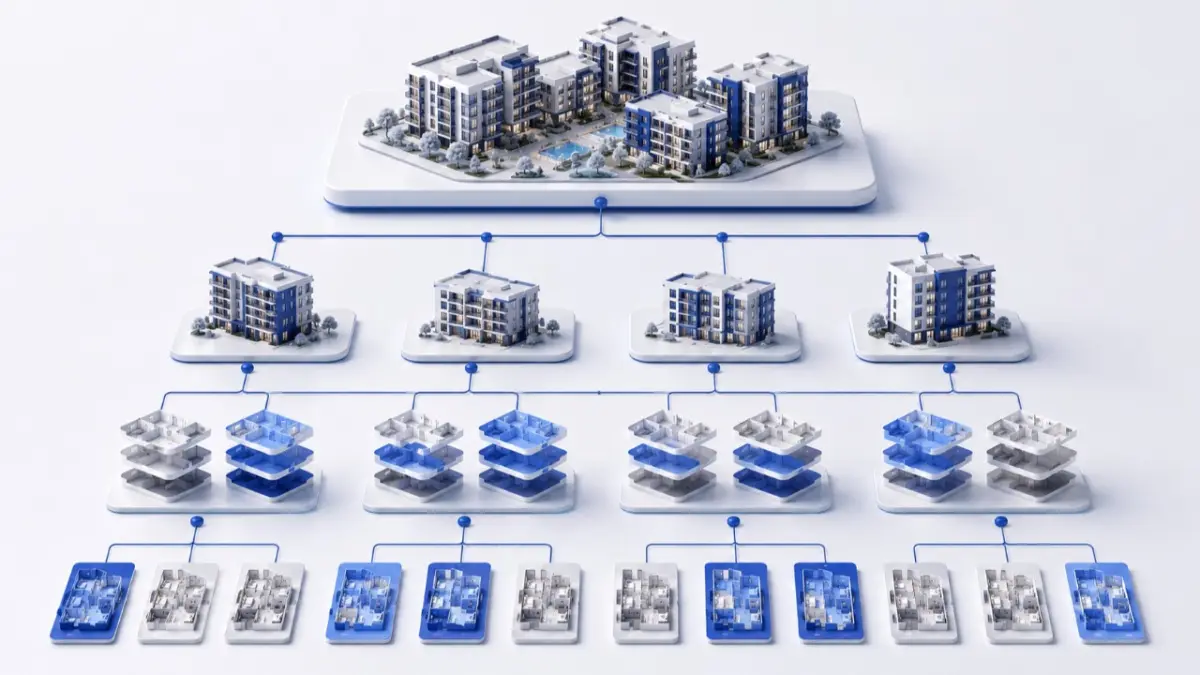
An MLS, or Multiple Listing Service, combines a property database, access rules and collaborative workflows. Agents, agencies and developers create records, keep them current and work from the same data. Understanding how MLS works means following a property from entry through search, updates, collaboration and distribution.
What Is an MLS and What Problem Does It Solve?
An MLS is not a property advertising website. A portal helps buyers discover properties, while an MLS organises the professional work behind them. Each record combines structured details, its status, the responsible participant and access conditions. Agencies can therefore work with shared inventory. The source remains responsible for the record, while the system controls how it may be used.
Who Works in an MLS and Who Owns the Data?
Participation depends on the market. Traditional systems serve brokers and licensed agents, while a private platform may also support agencies and developers.
The roles are divided by responsibility:
- the listing agent creates the property record and keeps it current;
- the buyer’s agent searches for options and contacts the listing representative;
- the agency manager assigns permissions and oversees the team;
- the developer manages projects, units, prices and availability;
- the platform administrator verifies participants and enforces the rules.
In practice, MLS data ownership remains with the authorised source, although specific legal rights depend on the platform rules and participation agreement. The platform stores the data and shows it only to the permitted audience.
How Is a Property Added to the Shared Database?
Before publication, a participant confirms the right to represent the property and collects its location, type, size, price, status and photographs. A development may also require plans, delivery dates, unit specifications and an availability matrix.
The steps below show the MLS listing process step by step:
- The participant creates a record and completes the required fields.
- Photographs, plans and relevant documents are attached.
- The system checks the completeness and format of the data.
- The owner selects visibility and distribution settings.
- Once approved, the property receives an identifier and becomes searchable.
Rules on how to list property on MLS platforms vary between markets. Documents and eligibility depend on local requirements, while resale listings and multi-unit projects require different data structures.
How Does an MLS Check Accuracy and Identify Duplicates?
MLS listing validation can detect missing fields, invalid formats and inconsistent statuses. A disputed record may need manual review. Technology cannot determine the real availability if the owner fails to report a change.
How MLS prevents duplicate listings varies by platform. A system may compare addresses, coordinates and photographs before flagging a match. Similar records should not always be deleted because a property may have more than one legitimate representative. Effective control reveals the origin of each record for an informed decision.
What Visibility Levels Can Be Applied?
Not every record is intended for the entire network. A listing may be visible to all eligible participants, remain within one agency or use partner-only visibility for a selected group. Before a project launch, this replaces a freely forwarded PDF with controlled access to a current record.
Common visibility options may include:
- access across the professional network;
- visibility within one company only;
- access for selected agencies or agents;
- delayed public distribution;
- publication of approved data on a website or portal.
Internal remarks, contact details and cooperation terms do not need to leave the professional environment.
How Does an Agent Find a Property for a Buyer?
An agent workflow begins with the buyer’s budget, location, property type and essential features. The agent filters the database, compares records and saves options. Alerts can highlight a new match or status change.
Without an MLS, an agent checks websites, messages, spreadsheets and old PDFs, then calls to confirm availability. A shared database shows structured information, the current status and the responsible participant. Final confirmation may remain necessary, but the risk of offering an unavailable property is lower.
How Does an MLS Organise Agency Collaboration?
An agency workflow depends on shared visibility and clear responsibility. Team members see who manages a property and whom to contact, while managers assign roles and prevent conflicting versions.
An MLS creates a consistent sequence:
- the buyer’s agent finds a suitable property represented by a partner;
- the agent checks its status and access conditions;
- the responsible professional is contacted;
- a viewing and the next steps are agreed;
- subsequent changes are followed in the shared system.
The platform does not replace negotiation. It lets professionals discuss the client and transaction instead of searching for the latest file.
How Does a Developer Manage Projects and Units?
MLS for property developers connects a project record with developer inventory management. The owner maintains plans, prices and unit statuses. This developer workflow gives partners current information while controlling its audience.
The difference becomes especially clear when availability changes:
- a spreadsheet requires someone to edit and redistribute information manually;
- an old PDF remains with every recipient after a new version is issued;
- a correction in a chat can disappear among other messages;
- in MLS for developers, partners return to the updated source record.
Websites and portals may receive the new status automatically, but timing depends on the integration. An immediate update across every channel cannot be assumed.
What Happens When a Price or Status Changes?
After publication, a price may change, a unit may be reserved, or a listing may be sold. The responsible participant updates the source record instead of distributing another file. Real-time inventory updates are possible when every part of the workflow supports them, but the greater value is one recognised place for checking information.
How Does an MLS Work with Websites, Portals and CRMs?
Where supported, IDX and syndication transfer approved fields to external channels. Through an API, a website can display current properties while a portal receives public information. Private remarks and partner-only inventory retain their original controls.
MLS integration with CRM and website tools connects different stages without mixing their roles. The MLS manages properties, the website presents inventory, and the CRM stores contacts and follow-up. Listing updates move outward while leads return to the company’s workflow.
How Does an MLS Differ from Other Working Tools?
The MLS vs CRM real estate distinction becomes clearer when we look at what each system manages. An MLS organises properties and cooperation, whereas a CRM organises clients and communication. Other tools also have specific roles:
- a property portal supports public search and collects enquiries;
- a website presents the brand and displays approved inventory;
- a spreadsheet can support limited internal tracking;
- a PDF captures information only at the moment it is created;
- a chat delivers information quickly but does not control later versions.
An MLS does not replace these systems. It provides the structured inventory they use.
Why Do MLS Models Differ Between Countries?
A private MLS platform vs traditional MLS comparison reveals two ways of organising a market. An association model regulates brokers within a territory, while a SaaS platform may connect verified participants where shared infrastructure was absent. An MLS in Cyprus may place greater emphasis on new developments and the flow of unit data from developers to agents. Structured records and controlled access remain broadly relevant; other rules are local.
What Does a Shared MLS Workflow Give the Market?
The value lies in the information flow. Each property has a responsible source, each participant has defined access, and every change has a place where it should be recorded.
A well-organised process can help teams:
- find properties that match buyer requirements more efficiently;
- view shared agency or partner-network inventory;
- reduce conflicting versions of the same information;
- manage project and unit availability;
- control the external distribution of property data;
- connect a property with the follow-up generated by an enquiry.
Verified, duplicate-free listings result from participant discipline supported by platform controls, not an automatic guarantee. Assess a workflow by following one property: where it is created, who changes its price and which version reaches the buyer.
How Can a Company Move to a Shared System?
Map the data sources, required fields, responsible team members, access levels and external channels. An MLS workflow review reveals where information becomes duplicated or outdated. This complete data flow shows how MLS works in practice. MLS RealtyHub can then serve as a shared space for inventory and collaboration while the CRM, website and portals retain separate roles.
Frequently Asked Questions
Can a Buyer Receive Full MLS Access?
Full access is generally reserved for verified professionals. Buyers see approved data through public channels or their agent.
Who Owns the Property Data?
Responsibility remains with the authorised representative. The MLS uses the data within its rules and visibility settings.
Are MLS and IDX the Same Thing?
No. The MLS is the source of professional inventory, while IDX displays an approved portion of that data on public real estate websites.
Can a Property Developer Work Directly in an MLS?
Yes, when developer accounts are supported. A company can maintain projects and units and give selected partners access.
Does an MLS Replace a CRM?
No. An MLS organises inventory and cooperation, whereas a CRM manages clients, enquiries and communication.
Author
This material was written by Maria Vashchenko.
For questions, collaboration, or further discussion, feel free to contact me on LinkedIn.