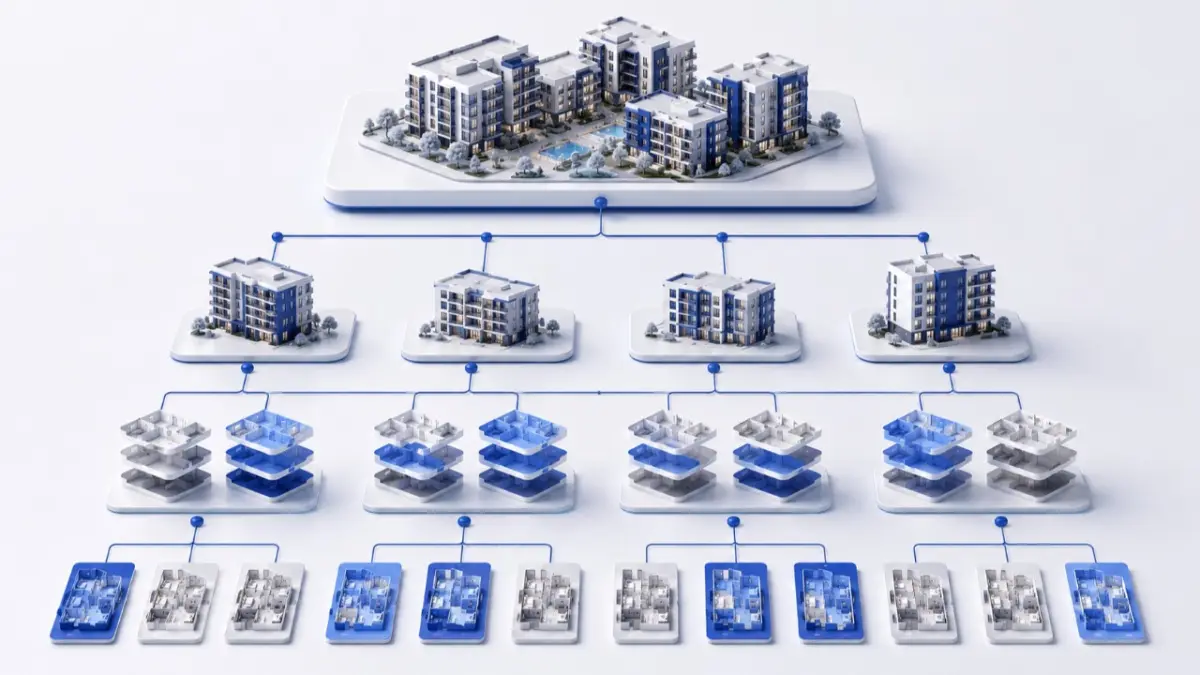
The future of mls cyprus is not simply about another property search tool. The question is whether developers, agencies and licensed professionals can work with structured project data, current availability and sharing rules. Cyprus has regulated agents, public platforms and official land data, but no reliable public evidence identifies one nationwide MLS equivalent to the largest North American systems. Its next stage is more likely to develop through practical workflows than one sudden market-wide change.
What would an MLS add to the Cyprus property market?
An MLS is professional infrastructure for entering, searching and sharing property records under defined rules. It is not interchangeable with a portal, CRM or developer inventory system, although these tools may exchange information.
Property portal
- Main purpose: Public discovery and enquiries
- Typical data owner: Advertiser or publisher
- Main limitation: Records may be duplicated or outdated
Agency CRM
- Main purpose: Lead and pipeline management
- Typical data owner: Agency
- Main limitation: Does not create shared inventory
Developer system
- Main purpose: Project and unit control
- Typical data owner: Developer
- Main limitation: May not distribute data to agencies
MLS or distribution platform
- Main purpose: Structured inventory and cooperation
- Typical data owner: Source developer or listing representative
- Main limitation: Value depends on participation and current source data
Cyprus already has parts of this infrastructure. Agents must be registered and licensed, Ktimatomesites.com presents listings submitted by licensed agents, and the Department of Lands and Surveys provides official land and transaction information. DLS records are not current marketing inventory, while a listing platform is not necessarily a broker-cooperative MLS. For new developments, the clearest use case is distribution of projects with multiple phases, buildings and changing unit records.
Which developments could matter most?
1. Structured project and unit records
Each project and unit needs a stable identifier, defined areas, price basis, availability status, construction stage, expected completion, parking or storage information, approved media and an update timestamp. Without common definitions, “available”, “area” and “price” can mean different things in different systems.
The Real Estate Standards Organization’s Data Dictionary is an international example, not a confirmed Cyprus standard. A local dictionary would need to reflect Cyprus project structures, bilingual terminology, VAT presentation and different area definitions.
2. Current availability with clear ownership
Central storage can reduce copied files and messages, but it does not make information accurate. Every record needs an owner, timestamp, clear status and correction or withdrawal process.
“Real-time” should describe a genuinely automated, near-immediate update. Where staff first confirm a change, “current as of [date]” is more precise. Current inventory is a business responsibility supported by software, not a software guarantee.
3. Controlled developer-to-agent distribution
A public project page may show approved facts and available unit summaries. Authorised agents may need a complete unit table, presentation materials and reservation procedure, while internal teams retain operational information. Role-based permissions can control who may view, edit, approve, download or export each type of material.
This gives agents a dependable reference while the developer retains control over commercial details. Controlled distribution is different from maximum public reach.
4. Interoperability between specialised systems
A developer system can remain the source of unit facts, an MLS distribute approved inventory, a portal support discovery and a CRM record follow-up. Verified integrations can reduce repeated entry.
The main risk is multiplying an error across channels. Each connection needs field mapping, ownership, monitoring and withdrawal. Availability should be checked for each product rather than assumed from the label next-gen real estate software.
5. Verification and governance
Verification must have a precise meaning. Confirming identity is not the same as checking an agent’s licence; professional status does not prove authority to market a unit; and developer-supplied information does not independently verify title, permits or legal compliance.
An MLS also needs participation rules for required fields, updates, duplicates, corrections and permissions. Cyprus need not copy another country’s structure, but a network cannot rely on interface design alone.
6. AI-assisted work with human review
Practical mls innovation may include extracting fields from spreadsheets, detecting possible duplicates, translating descriptions, classifying plans and renders, flagging missing data or enabling natural-language search. These functions still depend on structured and current source records.
Human review remains necessary because units may be merged, terms mistranslated or renders misclassified. GDPR duties and relevant EU AI Act requirements also need review when AI processes personal data or creates user-facing content.
What could slow adoption?
Barriers are organisational and commercial as well as technical. Agencies may be cautious about sharing; developers want distribution with control; participants may disagree on definitions, responsibility or cost.
A workable model requires:
- a clear commercial reason to participate;
- common project, unit and status definitions;
- named ownership of every source record;
- permissions and security for each user role;
- correction, withdrawal and dispute procedures;
- training for firms with different systems.
Coverage also affects trust. Duplicate or incomplete records weaken search and analytics. Asking prices are not completed transaction prices, and platform data cannot represent the complete Cyprus market without sufficient coverage. Adoption may remain fragmented, grow within new-build networks or develop toward interoperability. These are scenarios, not predictions; progress depends on active use, complete fields and current records.
How could this work for a Larnaca development?
Consider a fictional 60-unit apartment project working with six authorised agencies. The developer creates one project record with linked phase, building and unit IDs. Each unit includes defined areas, price, availability, expected completion, parking, approved plans, renders and Greek and English descriptions.
Public users see approved facts; agents see the current unit table; internal staff retain the update history. When unit B-204 is reserved, the developer changes its status, dates the update, withdraws active materials and informs the agencies. One agency without a CRM integration records buyer activity manually. The workflow improves consistency without removing every manual task. The developer remains responsible for price, availability and specifications.
Where does MLS RealtyHub fit?
Public MLS RealtyHub materials describe structured project and unit records, current prices and availability, approved materials, agent access and developer-to-agent distribution. These functions align with the workflow above and can provide agents with a controlled project reference.
This should not be extended into unconfirmed claims. Public evidence does not establish market-wide coverage, specific CRM integrations, AI matching, automated valuation, national regulatory status or guaranteed accuracy. APIs, audit history and automation remain general practices unless a current capability is verified.
What should developers and agencies prioritise now?
The priority is a dependable route from developer-owned facts to agent presentation and back to current unit status. Teams can name the source and update owner, define partner permissions and test how a reserved unit disappears from every channel.
To assess whether MLS RealtyHub fits this workflow, request a review of your current project data, agent distribution and availability process.
Frequently asked questions
What is the future of MLS in Cyprus?
The likely direction is structured project data, controlled distribution and connections between specialised systems. The pace remains uncertain because reliable nationwide adoption data is unavailable.
How could an MLS change the Cyprus property market?
It could help developers and authorised agents share current inventory, plans and project facts consistently. Its value depends on ownership, rules and participation.
How is an MLS different from a property portal?
A portal primarily supports public discovery and advertising. An MLS supports professional inventory, structured fields, permissions, update duties and cooperation. The two may be connected.
Can artificial intelligence improve MLS data?
AI can assist with extraction, duplicate detection, translation, media classification and search. Human review remains necessary because the output may contain errors.
What prevents MLS adoption in Cyprus?
Possible barriers include competition, data ownership concerns, inconsistent standards, incomplete inventory, cost, training needs and the absence of shared governance. No Cyprus-wide study ranks them.
Will an MLS replace agents or agency CRMs?
No. Agents handle qualification, communication and transaction support. A CRM manages contacts and sales activity, while an MLS primarily supports property information and distribution.
What role could MLS RealtyHub play?
Its public materials position MLS RealtyHub around structured project and unit information, approved materials, current availability and developer-to-agent distribution. Specific integrations and coverage should be verified directly.
How should this article be updated?
Review Cyprus licensing and platform information, EU requirements, MLS RealtyHub capabilities, examples, screenshots, internal links and FAQ answers annually or after a material change.
Author
This material was written by Maria Vashchenko.
For questions, collaboration, or further discussion, feel free to contact me on LinkedIn.