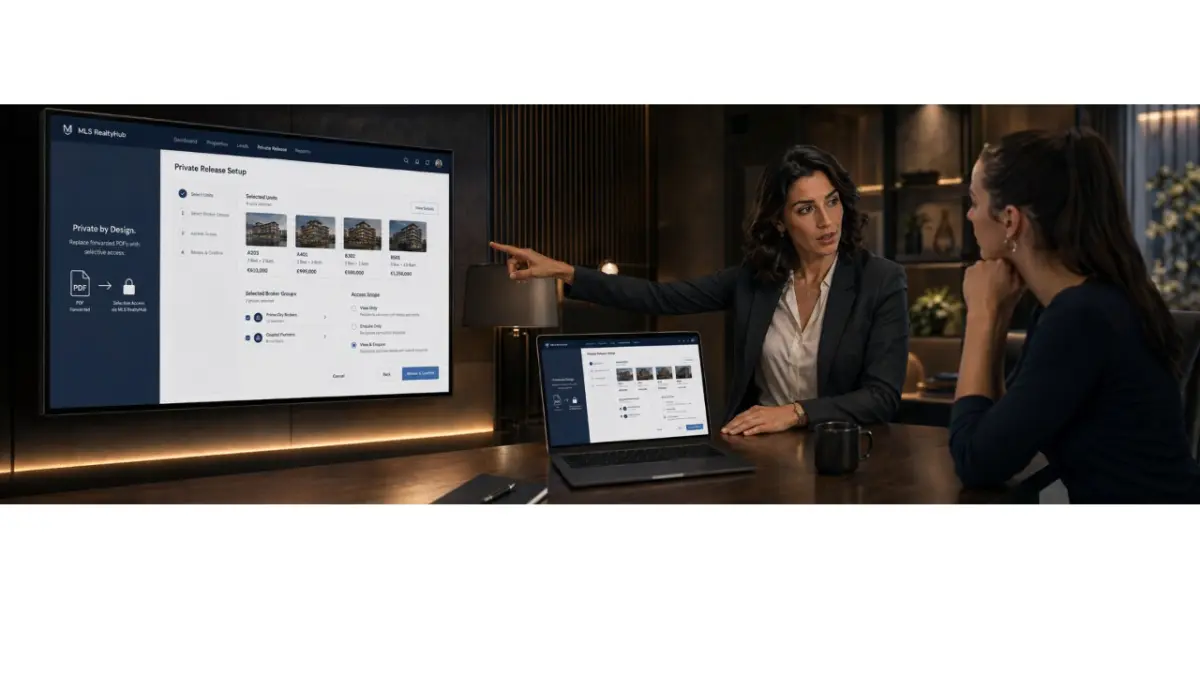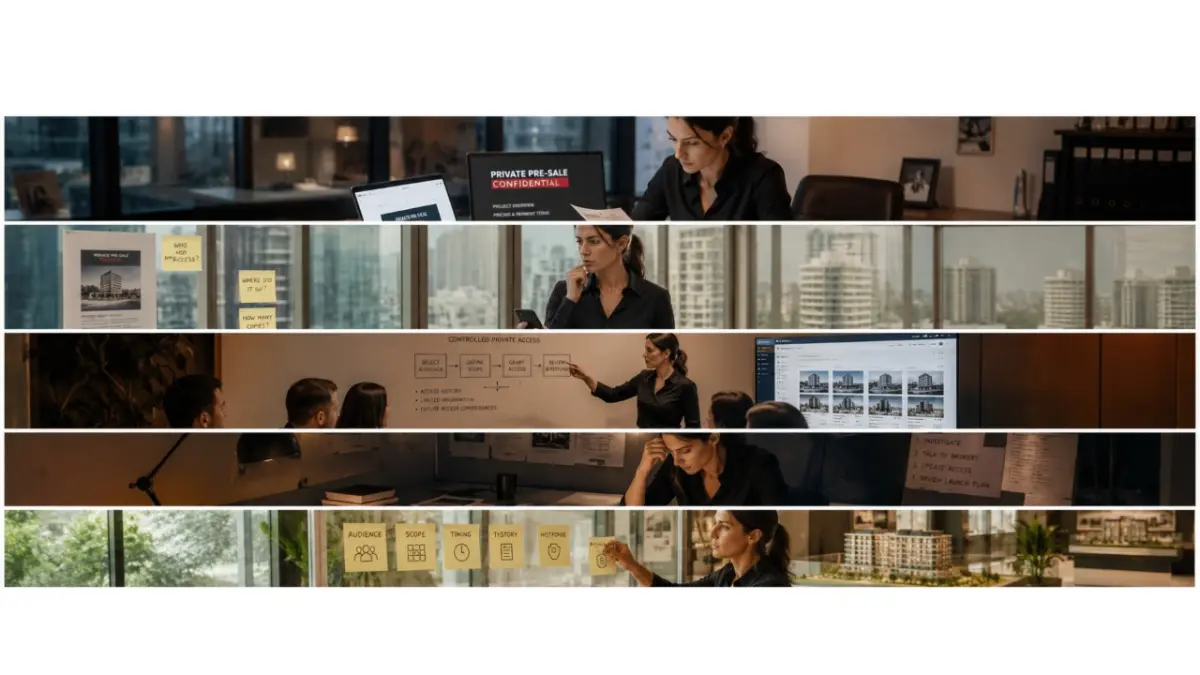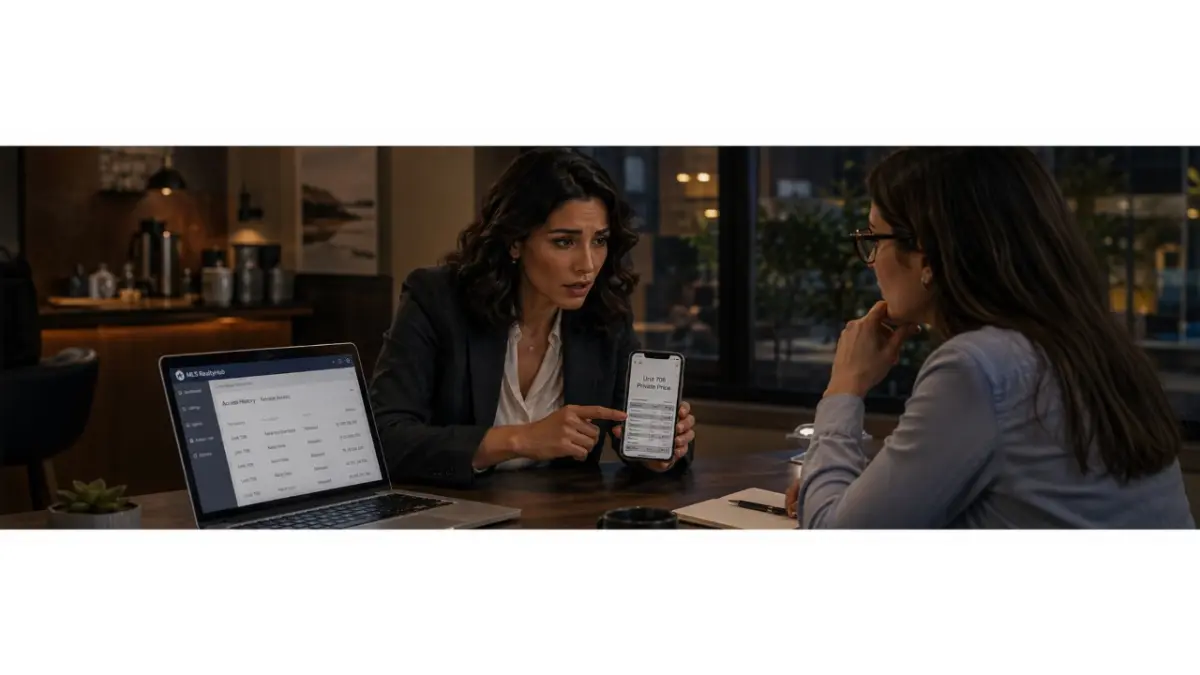
By Thursday morning, Myrto already knew what the first question would be. The day before, her team had rebuilt the next private release around selected access in MLS RealtyHub: specific broker groups, specific units and a defined offer scope instead of another confidential PDF sent to everyone. It was a cleaner process, but nobody in the room believed it made private information impossible to copy.
The sales manager arrived with coffee and stopped beside her desk.
“I’ve been thinking about yesterday.”
Myrto looked up.
“The screenshot?”
“The screenshot.”
She smiled.
“I knew you’d come back to it.”
“If a broker can still screenshot the price and send it to someone else, haven’t we just built a more sophisticated version of the same problem?”
It was a fair question, and Myrto had no interest in answering it with a promise the product could not keep.
“No,” she said. “But not because screenshots disappear.”
“Then why?”
“Because the problem was never that information could physically be copied. The problem was that we had no structure around who received it, what they received or what we could do afterwards.”
That distinction was the centre of Thursday’s discussion. The Week 9 plan explicitly rejects absolute promises around screenshots or screen photos. Controlled access is supposed to create a known audience, limited scope, access history and a practical response when the rules are broken — not pretend copying can be made technically impossible.
The first test came before lunch
At 10:40, one of the brokers from the new private release called the sales team.
A screenshot of Unit 708 had appeared in a WhatsApp group he was part of. It showed the unit number, the private price and part of the payment terms. The screenshot had clearly come from the new release, but there was no visible name on it and no obvious way to tell who had taken it.
The sales manager came straight to Myrto.
“We have one.”
“One what?”
“A screenshot.”
He placed the phone on her desk.
Myrto looked at the image.
“Can we prove who took it?”
“No.”
“Can MLS RealtyHub tell us who pressed a screenshot button?”
“No.”
“Good.”
The manager frowned.
“Good?”
“Good that we’re clear about that before we start telling ourselves stories.”
She enlarged the screenshot. The information was real. The unit was part of a restricted release and had not yet been opened to the broader broker network.
“So what do we actually know?” she asked.
The manager thought for a moment.
“We know which release it came from.”
“What else?”
“We know which brokers had access to that unit.”
“What else?”
“The time window.”
“And?”
He opened MLS RealtyHub.
“We have the access setup and history for that release.”
Myrto nodded.
“That’s where we start.”
The access history was useful because it gave the team visibility into who had been granted access within the private workflow. It did not prove who created the screenshot, and Myrto was careful not to confuse the two. In the Week 9 framework, access history is meant to support visibility and follow-up, not to act as forensic proof of who copied information.
They could not identify the screenshot, but they could define the exposure
On Monday, an unknown broker had appeared with the private price and the team had no meaningful starting point. The original PDF had been sent to twelve people, but after that the audience could have expanded indefinitely.
Thursday looked different.
Myrto opened the private release in MLS RealtyHub.
“Who could see Unit 708?”
The sales manager checked the scope.
“Five brokers.”
“Not nine?”
“No. We only opened 708 to five after yesterday’s request.”
“And was it visible to the second broker group?”
“No.”
“So we don’t know who took the screenshot, but we do know the original exposure was five people.”
“Yes.”
“That matters.”
The manager looked unconvinced.
“But the screenshot could already be with fifty people.”
“It could.”
“Then what exactly have we controlled?”
“The starting point, the scope and what we do next.”
Myrto was not trying to minimise the leak. Once an image had been copied and sent outside the system, MLS RealtyHub could not recall every copy from every phone. But unlike Monday’s forwarded PDF, the team knew precisely which private release the information came from and which defined audience had originally been allowed to see that specific unit.
That is the difference the content plan makes between absolute prevention and controlled risk: the system does not guarantee that copying will never happen, but it gives the developer a known audience, a limited scope and operational leverage after a breach.
“So what do we do with the five brokers?”
That was the next question.
The sales manager opened the group.
“Do we remove all of them?”
“No.”
“Then we ask who took it?”
“We can ask. But we shouldn’t accuse five people because we have one screenshot.”
“Then how do we respond?”
Myrto looked at the release details again.
“First, confirm exactly what information has moved outside the intended group. Second, speak to the brokers who had access. Third, decide whether the current release should stay open in the same form.”
The manager nodded slowly.
“And if we have a reason to believe someone ignored the private-access rules?”
“Then future access becomes part of the response.”
That was a much more useful lever than pretending the team could erase the screenshot. A developer might not be able to reverse information that had already been copied, but it could decide who should continue receiving restricted stock in the future.
The Week 9 plan calls this a future-access consequence: the ability to change or restrict someone’s participation in later private releases as a practical form of accountability.
“So we’re not saying, ‘We can stop screenshots,’” the manager said.
“No.”
“We’re saying, ‘Private access has rules, and breaking them can affect future access.’”
“Exactly.”
“That sounds less impressive.”
“It sounds more credible.”
The team changed the release instead of chasing the image
By midday, the screenshot had already travelled beyond the original broker group. There was no realistic way to know how many phones it had reached, so Myrto refused to spend the afternoon trying to count copies they could no longer see.
Instead, she looked at what was still under the developer’s control.
“Do we still want Unit 708 available to the same five brokers?” she asked.
The commercial team reviewed the situation. Two brokers were actively working with qualified buyers. One had not engaged with the unit at all. The remaining two were still relevant to the launch, but the team wanted to tighten the next stage while they clarified what had happened.
“Keep access for these two,” Myrto said. “Remove 708 from the others for now.”
The manager changed the access in MLS RealtyHub.
“What about the other units?”
“They stay as they are. The problem is with this offer, not the entire project.”
That was another difference from the old file-based process. If Unit 708 had been one page inside a PDF containing eight private units, the screenshot incident might have pushed the team towards withdrawing or replacing the entire document. With a defined access scope, they could respond specifically to the affected stock instead of treating the whole private launch as one indivisible file.
“Done,” the manager said.
“So the screenshot still exists,” Myrto replied, “but we’ve changed what happens next.”
He nodded.
For the first time that week, the team was not trying to undo the past. It was managing the next stage of the release.
A screenshot did not make the system pointless
Later in the afternoon, the sales director joined the discussion. He had seen the screenshot and was less patient with the distinction Myrto was making.
“I still don’t understand why we should call this controlled,” he said. “The information leaked.”
“Yes.”
“And we couldn’t stop it.”
“Correct.”
“So where is the control?”
Myrto turned the laptop towards him.
“Monday, we sent one file to twelve people. After that, we didn’t know the real audience, we didn’t know the scope of every copy, and we had no structured way to change access because the information had already left us as a document.”
She opened Thursday’s release.
“Today, we know which five brokers had access to this unit. We know which stock was included. We know the release window. We can review the access history inside the workflow, change who continues to see the private offer and make decisions about future releases.”
“But the screenshot is still out there.”
“Yes.”
She paused.
“Controlled risk does not mean zero risk.”
The room went quiet for a moment.
That was the uncomfortable part of private distribution that marketing language often tries to avoid. No portal, PDF or private platform can guarantee that a person who sees information will never photograph a screen, repeat a price to someone else or copy details manually. The product value begins when the developer stops treating that limitation as a reason to abandon access control altogether.
The Week 9 quality rules are explicit on this point: do not promise screenshots are impossible; explain the value through known audience, limited scope, access history and future-access response.
The real difference appeared in the next decision
Before the end of the day, Myrto received another question from the team.
A broker who had not been part of the Unit 708 audience now had a qualified buyer and wanted access to it.
The sales manager looked at Myrto.
“Do we open it?”
“Not yet.”
“Because of the screenshot?”
“Partly. We’ve just had a breach. This isn’t the moment to expand the audience automatically.”
“So we say no?”
“We say not now. If the client is serious, review the case and we decide whether to add that broker later.”
The manager leaned against the desk.
“That’s different from Monday.”
“How?”
“On Monday, once the PDF was out, we couldn’t really decide who joined next. People joined themselves.”
Myrto smiled.
“Exactly.”
This was the operational value she had been trying to define all week. Controlled private access was not a promise that information would never escape. It was the ability to make deliberate decisions before and after something happened: who enters the release, what they see, when access changes and what consequences follow if the rules are ignored.
A screenshot could still cross the boundary.
But the boundary itself no longer disappeared with it.
What Controlled Access Really Means
The screenshot did not prove that controlled private access had failed; it showed why control needs to be defined honestly. MLS RealtyHub cannot make screenshots or manual sharing physically impossible, and access history should not be treated as proof of who created a copy. What it can give a developer is a known starting audience, a limited offer scope, visibility into the access granted within the workflow and the ability to change current or future access when something goes wrong. That turns a leak from a situation where the team can only ask “Who has our PDF now?” into a process where it can investigate the relevant release, contain what is still controllable and decide how participation should change next. Private distribution is not about eliminating every risk; it is about having enough structure to respond when risk becomes real.
Author
This material was written by Maria Vashchenko.
For questions, collaboration, or further discussion, feel free to contact me on LinkedIn.