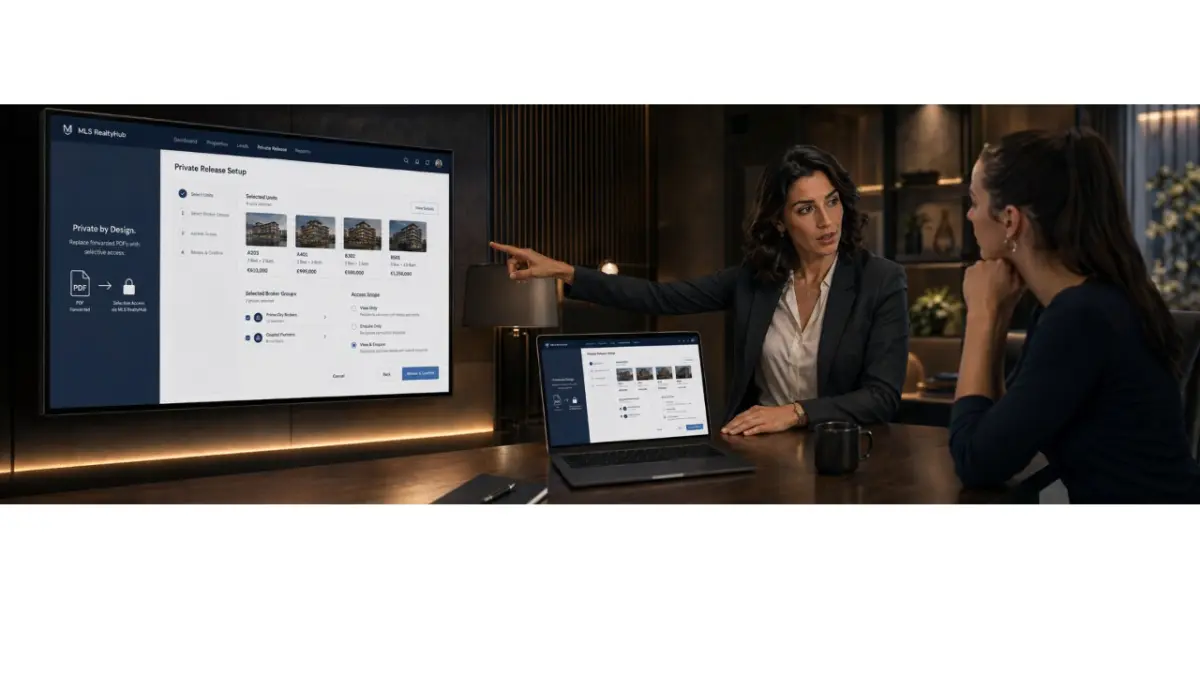
Myrto walked into the meeting room on Friday carrying nothing but her laptop. There was no presentation on the screen, no new price list waiting to be approved and no WhatsApp message drafted for brokers. The next private release was due on Monday, but after everything that had happened during the week, she had decided they would not begin by preparing something to send.
The sales manager came in a few minutes later.
“Are we reviewing Monday’s materials?”
“Not yet.”
“The release is in three days.”
“I know.”
“So what are we reviewing?”
Myrto opened MLS RealtyHub.
“The launch.”
He pulled out a chair.
“I thought that was what I meant.”
“No. You meant the materials. That’s exactly the habit I want to get rid of.”
On Monday, the team had treated a confidential presentation as the centre of the private pre-sale. By Friday, that idea felt almost backwards. The presentation had never been the launch. It had only been one piece of information moving through it.
What mattered was everything around that information.
They started with the brokers they actually wanted
Twenty-three brokers had shown interest in the project during the week. Some had contacted the developer directly. Others had heard about the offer through the same uncontrolled circulation that had caused the original problem.
The sales manager opened the names.
“How many do you want for Monday?”
Myrto scanned the list.
“How many of them have buyers who are relevant now?”
He filtered the contacts.
“Eleven.”
“Relevant buyers, not people who said they might have someone.”
He checked again.
“Eight for certain. Maybe two more.”
“Then we start with eight.”
He looked at her.
“That’s smaller than the first launch.”
“That’s fine.”
“We could get more reach with fifteen.”
“We are not trying to maximise reach on Monday.”
That answer would have sounded strange to the team a week earlier. More brokers had always seemed to mean more opportunities. But a private phase had a different purpose. It was meant to give a defined audience early access before the developer deliberately widened distribution.
The manager selected the eight brokers in MLS RealtyHub.
“What about the other fifteen?”
“They’re not rejected. They’re just not in this phase.”
“So we can add them later?”
“If there is a reason to.”
Myrto looked at the selected group again.
For the first time, the audience was not simply the result of whoever happened to receive a file. It was a commercial decision made before the release began.
That distinction sits at the centre of the private-launch model: scarcity depends on a real boundary around the audience, not merely on the word Confidential attached to the offer.
Then Myrto removed half the stock
The manager opened the units planned for the next phase.
“Twelve available.”
“We’re not opening twelve.”
“How many?”
“Five.”
He turned towards her.
“Only five?”
“For this group, yes.”
“Why keep the others back if they’re available?”
“Because available doesn’t have to mean available to everyone at the same time.”
She pointed to two units.
“These stay for the wider broker release.”
Then another.
“This one stays out completely until we review Monday’s response.”
The manager selected the five units in MLS RealtyHub and checked what the broker group would see.
“Five units, current prices, plans and the related materials.”
“Good.”
“That’s it?”
“That’s it.”
Earlier in the week, the team had thought about privacy at project level. Either the development was private or it was public. Now Myrto was thinking at stock level. A project could be known across the market while a specific group received access to only a particular part of the offer.
That was the practical value of access scope. In the Week 9 framework, access is not defined only by who can enter; it also covers which units, prices, terms and materials are visible to that audience.
The sales manager leaned back.
“So if somebody asks for one of the other units?”
“We decide whether they should see it.”
“Individually?”
“If necessary.”
“That is going to create more decisions for us.”
“Yes.”
He waited.
Myrto smiled.
“That’s called managing the launch.”
Monday would no longer have an open-ended finish
The next question was timing.
The old pre-sale had technically started at 9:30 on Monday, but nobody had really defined when its private phase ended. The team had expected to make the project public later in the week, yet the information had spread faster than their own release schedule.
This time Myrto wanted the sequence to be deliberate.
“When do the eight brokers get access?” she asked.
“Monday at nine?”
“Good. When do we review whether to expand?”
“Wednesday afternoon.”
“And if we have strong buyer activity?”
“We keep the group limited longer.”
“If we don’t?”
“We widen access on Thursday.”
Myrto nodded.
“Now we have timing.”
The sales manager typed the review point into the launch notes.
“So Thursday isn’t automatically public.”
“No. Thursday is a decision.”
That difference mattered. A controlled release was not simply a document released early. It had stages. The developer could start narrowly, evaluate demand and then decide when broader distribution made commercial sense.
The plan for the week treats timing as part of access governance for exactly that reason: once the market begins expanding the audience on the developer’s behalf, the developer loses part of the scarcity it intended to create.
This time, nobody would have to reconstruct the launch from chats
The sales manager opened the current access setup in MLS RealtyHub.
“Eight brokers. Five units.”
Myrto nodded.
“If two more brokers are added on Tuesday?”
“The access changes here.”
“If one unit is removed?”
“Same place.”
“If I ask you next Friday who was in the first phase?”
“We can review the access history.”
That was the part of the new process she valued more with every conversation.
During the first launch, reconstructing what had happened required searching WhatsApp, checking spreadsheets, asking managers who had sent what and trying to remember which file version each broker had received. The story of the launch existed in fragments.
Now the decisions lived inside a defined workflow.
Myrto pointed at the screen.
“This is what I want us to stop doing.”
“What?”
“Treating memory as infrastructure.”
The manager laughed.
“That bad?”
“You spent half of Tuesday asking people whether they remembered forwarding a PDF.”
“Fair.”
Access history did not mean the team suddenly knew everything a broker did outside MLS RealtyHub. It did not identify who created a screenshot or prove who repeated a private price. Its value was narrower and more useful: the developer could see the access it had granted and use that information as a basis for follow-up.
Then Myrto deliberately planned for something to go wrong
The sales manager had almost finished the setup when Myrto stopped him.
“One more thing.”
“What?”
“Assume the price gets shared again.”
He stared at her.
“That’s optimistic.”
“It’s realistic.”
“You want to plan the leak before we launch?”
“I want to plan our response before we need it.”
She closed the unit view.
“Someone outside the group gets one of the private prices. What happens first?”
“We identify which unit.”
“Then?”
“Check which audience had access.”
“Then?”
“Speak to the relevant brokers.”
“And if we have enough reason to believe someone ignored the access rules?”
The manager looked at MLS RealtyHub.
“We review whether they keep access.”
“Current and future.”
He nodded.
“Okay.”
Myrto had spent most of her career seeing confidentiality as a prevention problem. Put the right warning on the document. Choose trusted partners. Tell them not to distribute the information.
Thursday had changed that.
Prevention mattered, but it was not enough. A private-launch process also needed an answer for the moment when information moved beyond its intended audience.
That did not mean accusing people without evidence. It did not mean pretending an escaped screenshot could be pulled back from every phone. It meant having an operational response rather than discovering after the fact that nothing had been planned.
The content framework describes this as controlled risk: the objective is to manage the likelihood and consequences of a leak without claiming that copying can be made impossible. Future access can become part of that accountability when appropriate.
The difference was visible when they looked at Monday again
Before the meeting ended, the sales manager reopened the spreadsheet from the first launch.
Twelve names filled the screen.
“That feels ancient now,” he said.
“It was four days ago.”
“I know.”
On Monday, the spreadsheet had seemed sufficient. Twelve trusted brokers had been chosen. Twelve private messages had been sent. Twelve recipients had received a confidential presentation.
Everything after that had been left largely to trust.
Myrto opened Monday’s new release beside it in MLS RealtyHub.
The contrast was simple.
This time, the team knew who was being admitted to the private phase. It had chosen which stock those brokers could see. It had defined when the release would be reviewed and potentially expanded. It could revisit the access granted during the process. And it had already agreed on what the team would do if private information surfaced outside the intended group.
The manager looked between the two screens.
“So what do we call Monday’s launch?”
Myrto shrugged.
“Private.”
He smiled.
“We called the last one private too.”
“That was the problem.”
“What’s different now?”
She looked at the old spreadsheet.
“Last time, private was a label.”
Then she turned back to MLS RealtyHub.
“This time, it’s a set of decisions.”
Before they left, one final question remained
The manager closed the old spreadsheet.
“So if you had to check a private launch before it goes live, what would you ask?”
Myrto thought for a moment.
“Who is getting in?”
He nodded.
“What are they getting?”
“Yes.”
“When does that access change?”
“Yes.”
“What can we review later?”
“And?”
He already knew the last one.
“What do we do if the rules are broken?”
Myrto closed her laptop.
“That’s the launch.”
No confidential stamp could answer those questions. A WhatsApp message could not answer them either. They belonged to the process behind the release.
The Week 9 recap is built around those same controls — audience, scope, timing, history and response — because together they distinguish a managed private release from a file that simply happens to be sent to a small group first.
What Changed by Friday
By the end of the week, Myrto had stopped treating confidentiality as the defining feature of a private pre-sale. The real difference was whether the developer could make deliberate decisions about who enters the release, which stock and terms they can access, when those boundaries change, what access can later be reviewed and how the team responds when information moves beyond the intended group. MLS RealtyHub does not make human sharing impossible, and it does not turn every leak into something that can be reversed. What it changes is the structure around the launch: instead of sending a file and hoping the market respects its label, the developer runs a controlled process with defined access before the wider market gets to decide the boundaries for them.
Author
This material was written by Maria Vashchenko.
For questions, collaboration, or further discussion, feel free to contact me on LinkedIn.