Data Security MLS Guide for Cyprus Real Estate Teams
Learn how Cyprus real estate teams can protect listing data, buyer information, CRM connections, permissions, backups and MLS integrations.
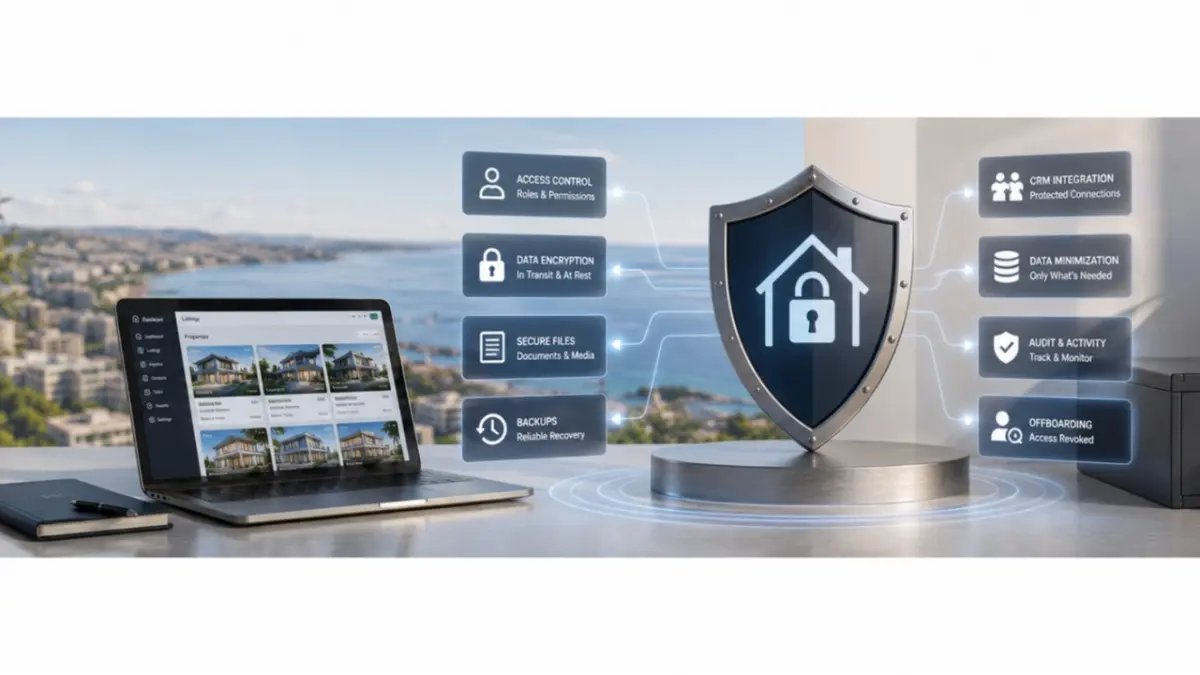
Data security in a real estate MLS is not only about having a “secure platform.” It starts with everyday operational choices: who can view a buyer inquiry, who can edit a listing record, who can download project documents, how long contact data is kept, which systems connect to the CRM and what happens to access when an agent leaves the team. A data security MLS helps agencies, developers and corporate real estate teams in Cyprus keep listing data, client information, user roles, permissions, backups and integrations inside a more controlled workflow instead of spreading them across chats, spreadsheets, cloud folders and personal devices.
When an MLS becomes a data risk
An MLS environment becomes sensitive when it starts connecting not only properties, but also people, actions, documents, inquiries and external systems. Buyer names, emails, phone numbers, viewing notes, seller contacts, internal comments, unit availability, project media, CRM records and dashboard activity may all sit inside or around the same workflow. Some of this data is personal data, some is commercially sensitive and some is simply critical for daily sales operations.
Common risks for real estate teams include:
- buyer contact details being shared through personal chats without clear access control;
- old project files continuing to circulate after prices or availability change;
- spreadsheets being shared with too many agents, partners or external users;
- CRM records and MLS records showing different versions of the same lead or listing;
- former staff keeping access after offboarding;
- dashboards exposing more information than each role actually needs;
- documents and media being sent through external links with no clear access history.
Data that should not live in chats and spreadsheets
For an agency, a listing may look like public information, but the workflow around it often contains sensitive details: internal notes, price changes, reserved units, seller conditions, unpublished project data, viewing history and documents that should not move freely between agents, partners and external channels. When that information lives in chats and spreadsheets, the team quickly loses control over which version is current, who has seen it and whether it should still be used.
A secure MLS workflow keeps data attached to a working record instead of a random file. The listing record, approved media, buyer inquiry, unit status, CRM-related notes and project documents should have clear context: who created the record, who can edit it, who can share it, when it was updated and whose access should be removed when they no longer work with that property, team or partner account.
GDPR context without legal promises
For Cyprus real estate teams, GDPR matters because buyer and seller workflows often involve personal data. A name, phone number, email, ID-related detail, investment preference, viewing note or seller contact can identify a person, so it should not be treated as ordinary “working information” with no restrictions. Real estate teams need practical habits around data minimization, access control, storage limits, accuracy and controlled sharing.
The term GDPR-compliant MLS should be used carefully. A platform may support GDPR-aligned operations through permissions, retention logic, privacy request workflows and safer data handling, but it should not be described as a legal compliance guarantee unless that claim is confirmed by the product and legal review. A safer and more useful approach is to explain what teams should look for: limited access by role, only necessary data collected, old data reviewed instead of kept forever and a clear process for access, correction or deletion requests.
Secure access, files and offboarding
A strong security workflow should help the team avoid everyday mistakes, not just protect the system in theory. An agent may need access to active listings, but not to every internal document. A developer may need to manage project data, but not see all buyer records inside the agency. A manager may need process visibility, but not always a full export of personal details.
Practical controls to look for include:
- role-based permissions for agents, managers, admins, developers and partners;
- controlled access to project files, approved media and documents;
- export limits for contacts, listing reports, project records and dashboards;
- activity history, when the platform supports change tracking;
- retention rules for old leads, archived listings and documents;
- offboarding processes for former employees, agents and partners;
- restricted sharing instead of uncontrolled external links;
- backup processes for recovery after accidental deletion, corruption or system failure.
Integrations as the hidden risk layer
The weakest point is often not inside the MLS itself, but between the MLS, CRM, website, portals, analytics tools and external lead systems. Once data starts moving between platforms, the agency needs to know which fields are being shared, who approved the connection, where copies are stored and what happens if synchronization fails. Without that clarity, teams can end up with duplicate records, stale availability, inconsistent follow-up and weak control over buyer data.
In the context of API security real estate, the question is not only whether integrations exist. The better question is whether they are authenticated, permissioned and understandable for the team. A data backup MLS process also matters as part of business continuity, because listing records, media or inquiry data can be deleted, corrupted or lost through human error or technical failure. When discussing encryption MLS, it is safe to explain the principle of protecting data during transfer and storage, but specific standards, protocols or certificates should only be mentioned if the product confirms them.
Data workflows protect trust, not just files
Data security in an MLS protects more than documents. It protects buyer trust, developer control, agency reputation and the team’s ability to respond accurately. If old files keep circulating, former agents still have access, CRM and MLS records drift apart and buyer contacts live only in chats, the problem is no longer only technical. It becomes operational and commercial.
A strong MLS environment does not make a company automatically compliant, replace legal review or guarantee that no data breach can happen. Its practical value is more specific: less unnecessary access, cleaner records, clearer roles, controlled integrations, backup logic and more careful handling of personal data. For real estate teams in Cyprus, that is part of professional infrastructure, because trust is shaped not only by the quality of the properties, but also by how the team handles buyer, seller and partner information.
Q&A
What does data security MLS mean in real estate?
It refers to the processes, access rules and technical controls inside an MLS platform that help protect listing data, client information, documents, team activity, integrations and export permissions. In practical terms, it is about who can see data, who can change it, how data moves between systems and how the team reduces uncontrolled sharing.
What data should real estate teams protect inside an MLS?
Teams should protect buyer contacts, seller information, inquiry details, viewing notes, internal comments, project documents, unit availability, media, CRM-related records and dashboard data. Some of this information may be personal data, while other parts may be commercially sensitive for the agency or developer.
What is a GDPR-compliant MLS?
This phrase should not be used as a legal promise unless the claim is confirmed. A more accurate way to explain it is that an MLS platform can support GDPR-aligned workflows through access control, data minimization, retention logic, secure sharing and privacy request processes.
Why are spreadsheets and chats a data privacy risk?
They move information outside a controlled environment. An old file is hard to withdraw, access is difficult to remove, change history is often unclear and buyer information can reach people who no longer need it for the work.
How is API security real estate connected to MLS software?
When an MLS connects with a CRM, website, portals or analytics tools, data moves between systems. API security helps limit those connections, protect authentication, control the fields being shared and reduce unnecessary exposure.
Why does an MLS platform need a backup process?
Backups support business continuity. If listing records, documents, media or lead data are accidentally deleted, damaged or lost because of a technical issue, the team needs a clear recovery process. Specific backup frequency should only be stated when confirmed by the platform.
What does encryption MLS mean in simple terms?
It means protecting data while it is being transmitted and while it is stored, so the information is not easily readable if it is intercepted or accessed improperly. The principle can be explained in general terms, but specific standards or protocols should not be claimed without confirmed product information.
Can data privacy MLS replace a company’s compliance work?
No. An MLS workflow can help limit access, reduce unnecessary data collection, support cleaner storage and improve controlled sharing. Legal review, data protection policies, processor contracts and compliance decisions remain the responsibility of the company and its specialists.
Author
This material was written by Maria Vashchenko.
For questions, collaboration, or further discussion, feel free to contact me on LinkedIn.