MLS API for Cyprus Real Estate Teams
Learn how MLS APIs connect websites, CRM systems, IDX feeds, dashboards and listing data for cleaner real estate workflows in Cyprus.
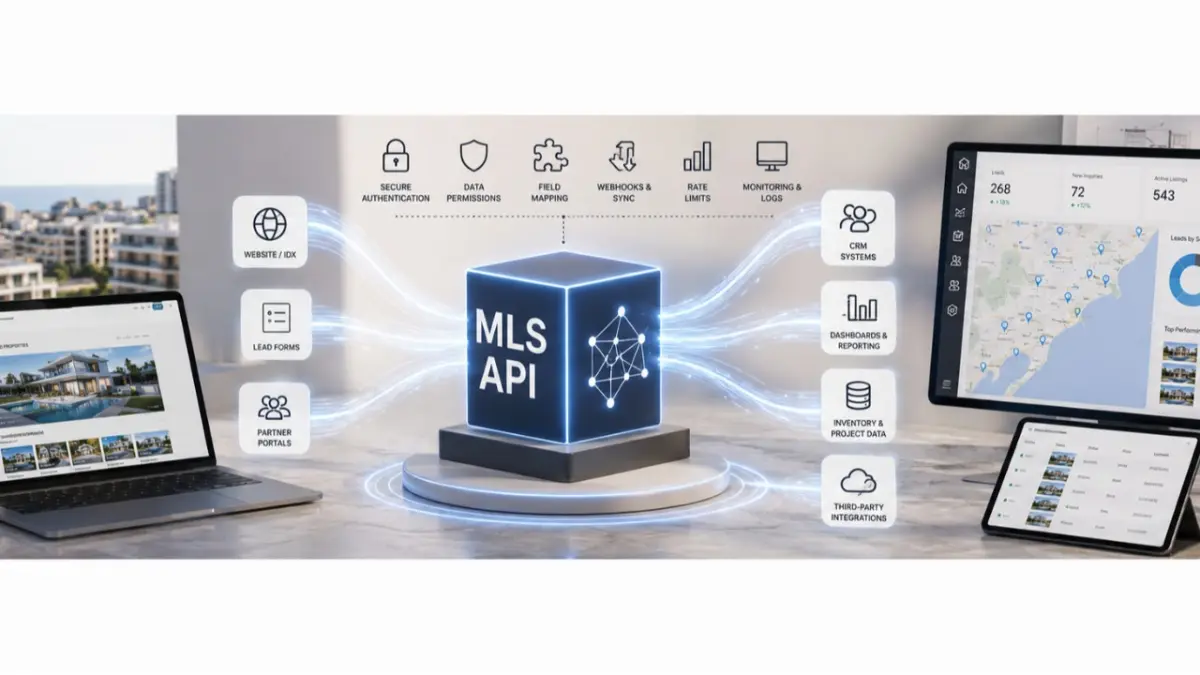
As an agency or developer team grows, property data rarely stays in one place. Listings appear on the company website, inquiries move into the CRM, project pages need updates, portals require feeds and managers want dashboards that show activity. An MLS API connects the MLS platform with websites, CRMs, lead forms, dashboards, portals and internal systems, so teams do not have to copy the same property records by hand and accidentally create several versions of the same information.
The API layer behind connected real estate workflows
In a practical real estate workflow, the API works as the bridge between the MLS database and the tools the team already uses. Instead of manually updating price, status, photos, descriptions, unit availability or lead source across multiple systems, the team can build a controlled data exchange between them. This matters in Cyprus real estate, where one project may be handled by a developer, an agency, external partners, website visitors, CRM users and marketing channels at the same time.
An MLS data API can support the movement of structured listing fields, project metadata, media, status updates, price changes, inquiry signals and other operational data, depending on what the platform actually provides. The important point is not to promise that every field moves everywhere in real time. A strong integration setup should make clear which fields are available, who can use them, how sync errors are handled and who owns the integration after launch.
Websites, project pages and IDX display
For an agency or developer website, API connectivity can turn static property pages into a more reliable listing experience. Instead of rebuilding pages manually, the website can receive current records from the MLS and show buyers fresher information: property status, images, features, location details, price range, project data or available units. That reduces the risk of showing old prices, unavailable listings or outdated media.
IDX integration usually refers to the public-facing layer that displays MLS listings on a real estate website. For buyers, it may look like search results, filters, listing cards or project pages. For the team, the real value is operational: data must refresh reliably, fields must be mapped correctly and display rules must match what the business is allowed to show publicly. It should not be claimed that IDX is always included, real-time or suitable for every website unless the product confirms those details.
CRM, lead forms and listing context
When a buyer submits an inquiry from a website, the team needs more than a name and phone number. They need to know which listing the buyer viewed, which project page created the interest, which source brought the lead, which agent should follow up and whether the property data is still current. Without that connection, the CRM becomes a contact list and the MLS remains a separate property database.
CRM MLS integration helps connect buyer activity with the listing or project record that generated it, if this workflow is supported by the platform and the CRM stack. This is especially useful for teams that work with website forms, portals, partner referrals, paid campaigns and direct requests. When data drifts between systems, teams get duplicated contacts, inconsistent notes, stale preferences and broken attribution. The result is weaker follow-up and less reliable reporting.
Architecture built for extension
The technical value of an API is not limited to a single website connection. A real estate SaaS platform needs an architecture that can support different workflows without rebuilding the core system every time. One team may need a website feed, another may need project inventory sync, a corporate user may need reporting and a technical team may want to connect internal admin tools or dashboards.
In this context, plugin architecture MLS means the platform can be extended through separate components instead of heavy custom work inside the core database. Later, add-on modules MLS can support specific tasks such as analytics, CRM connectors, listing feeds, partner access, reporting or website display. These should be explained as product categories unless the platform confirms exact modules. For a developer-focused article, the useful idea is simple: modular architecture makes the integration roadmap easier to manage and reduces dependency on manual operations.
Technical teams should also look at the working details behind the API:
- Authentication: which user, app or system is allowed to access the API.
- Permissions: which records and fields can be read, changed or transferred.
- Data mapping: how fields match between the MLS, CRM, website and dashboard.
- Webhooks: how systems can receive change signals, if this is supported.
- Rate limits: how the API prevents overload from too many requests.
- Error handling: what happens when a sync fails or a field does not match.
- Monitoring: who can see integration problems and resolve them.
- Documentation: how clearly developers can build and maintain the connection.
- Sandbox: whether integrations can be tested away from live listings, if available.
Integration mistakes that break the workflow
The biggest mistake in MLS integration is often operational, not technical. A team connects systems but does not assign ownership. Nobody knows who manages field mapping, who checks sync errors, who updates website display rules, who verifies CRM attribution or who stops manual workarounds when an integration is not working correctly. An API should reduce manual work, not create a new layer of uncertainty.
Common problems include:
- website listings staying outdated after a status change in the MLS;
- CRM leads not being linked to the property record that generated them;
- portal updates continuing manually after the source data has changed;
- availability changes not reaching project pages;
- media or documents moving without clear display rules;
- dashboard activity being based on incomplete or duplicated records;
- sync errors going unnoticed until an agent or buyer reports a problem;
- external systems receiving more fields than they need for the workflow.
From connected tools to a controlled tech stack
A strong API stack is not valuable because “integrations” sound modern. It is valuable because listings, leads, website display, CRM records, dashboards and portals can work from a cleaner source of truth. For Cyprus real estate teams, this matters because one property may appear across several sales channels at once, while the buyer may make a decision faster than the team can manually update every copy of the data.
RealtyHub MLS should be positioned carefully here: as a private MLS and SaaS environment where integrations can help connect property data with the systems teams use every day. Exact endpoints, named connectors, refresh frequency, webhook support, sandbox access, uptime, real-time sync and API security details should only be stated when confirmed by the product. The safe and useful message is that API-connected workflows reduce manual re-entry, limit data drift and help teams build a more controlled real estate tech stack.
Q&A
What is an MLS API in real estate?
It is a software interface that allows an MLS platform to exchange listing data and workflow information with other systems, such as websites, CRMs, dashboards, portals, lead tools and internal admin systems. Its practical role is to reduce manual copying across multiple places.
How does an MLS data API help agencies and developers?
It can help move structured listing fields, project metadata, media, status updates, price changes, unit availability and inquiry signals between systems, depending on what the platform supports. This reduces duplicated records, stale listings and manual errors.
What does IDX integration mean for a real estate website?
It is a way to display MLS listings on an agency or developer website through a connected feed or plugin-based logic. The key requirement is that the displayed data is reliable, mapped correctly and aligned with what the business is allowed to show publicly.
Why does CRM MLS integration matter?
It connects buyer inquiries with the listing or project that created the interest. This improves lead attribution, follow-up quality, reporting and the team’s understanding of which properties actually generate demand.
What is plugin architecture MLS in simple terms?
It means the MLS platform can be extended through separate components or connectors instead of rebuilding the core system every time. This is useful when different teams need different workflows.
How can add-on modules MLS support a real estate team?
They can support specific functions such as website feeds, reporting, CRM connectors, analytics, partner access or listing distribution. Exact modules should only be described if the platform confirms them.
What can go wrong with a weak API integration?
Teams may end up with outdated website listings, broken lead attribution, duplicate records, missing availability updates, unnoticed sync errors, weak monitoring and unnecessary exposure of data fields.
Can an MLS API guarantee real-time sync?
No, not unless the product confirms it. It is safer to describe API workflows as connected data exchange that can reduce manual re-entry. Refresh frequency, webhook support and sync guarantees should only be stated when officially verified.
Author
This material was written by Maria Vashchenko.
For questions, collaboration, or further discussion, feel free to contact me on LinkedIn.