MLS Support and Onboarding for Sustainable Platform Adoption
Assess MLS onboarding, training, documentation, help desk quality, integration support, and long-term adoption before choosing a platform.
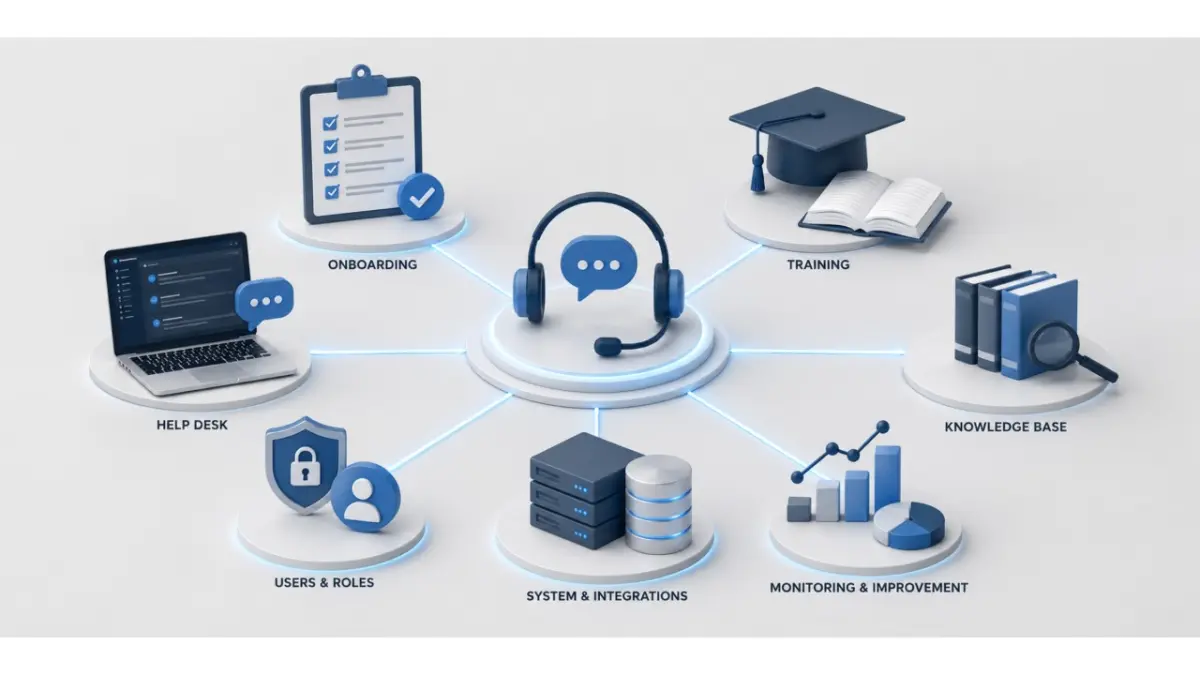
The value of an MLS depends on more than its technical features. Even a capable platform will fail to improve daily operations when users do not understand how to create listings, update statuses, manage access, or respond to errors. Support should therefore be evaluated as a complete service covering implementation, corporate account configuration, training, documentation, technical assistance, and continued guidance after launch.
Support Begins Before the First Ticket
MLS user support includes every form of assistance that helps a company adopt and use the platform safely and consistently. It may begin with implementation planning, account configuration, user permissions, and data migration before continuing through onboarding, training, documentation, technical support, and post-launch guidance.
When support begins only after an error appears, the problem may already have affected the wider workflow. Incorrect permissions can expose confidential information, an unchecked data import can create duplicate listings, and unclear publication rules can lead part of the team to use the MLS while others continue working through spreadsheets and outdated PDFs.
Effective support is therefore preventive as well as reactive. It should help the company configure the system correctly, teach users how to complete their work, and provide specialist assistance when standard guidance is not enough.
Distinct Roles of Support, Onboarding, and Training
Several services contribute to platform adoption, but they serve different purposes:
- Customer support resolves functional questions and user-reported problems.
- Technical support handles integrations, imports, API failures, and complex system errors.
- Onboarding moves the company from account creation to independent daily use.
- Implementation covers configuration, migration, integrations, and the initial launch.
- Training teaches users to complete tasks that match their responsibilities.
- Customer success evaluates whether the platform is producing the intended operational improvement.
- Self-service guidance provides instructions, videos, and contextual help for standard tasks.
A help desk MLS team may investigate why an import failed. The onboarding process should have already explained the required data structure and validation steps. After launch, customer success may review whether employees are using the import process correctly or have returned to maintaining unofficial spreadsheets.
These services work together, but one cannot replace the others. A responsive help desk does not compensate for poor implementation, while a single training session does not remove the need for ongoing technical support.
A Practical MLS Onboarding Process
Effective onboarding MLS programmes are built around real business processes rather than a general tour of the interface. Users need to understand how the platform supports their work and what happens after each action.
A corporate implementation may include:
- Defining the processes and objectives moving into the MLS.
- Configuring offices, teams, user roles, and access rights.
- Creating individual accounts and assigning permissions.
- Importing listings and checking required fields and duplicates.
- Connecting websites, portals, CRM systems, and other integrations.
- Training users and testing critical workflows.
- Reviewing early adoption and correcting configuration issues.
The scope depends on the organisation. A small office may not require a complex migration or phased rollout. A company with several branches, external partners, and multiple publication channels may need a pilot launch before extending the platform to the full team.
A responsible administrator is also required on the client side. The provider can explain the available settings, but it cannot decide which employees should change prices, publish listings, access buyer data, or manage integrations. Those decisions depend on the company’s internal structure and policies.
Role-Based Training and Practical Documentation
The same training programme is rarely suitable for every user. Agents need to search for properties, build selections, and manage enquiries. Listing coordinators need to understand required fields, media standards, and publication controls. Administrators are responsible for users, permissions, security, and account configuration.
Effective training modules MLS should therefore be organised around roles and tasks:
- core workflows for agents;
- listing creation and data-quality control;
- lead and client management;
- publication through connected channels;
- corporate account administration;
- reporting and operational oversight;
- integrations, security, and error handling.
Complex account structures and integration settings often benefit from live training. Routine operations are easier to reinforce through short videos, written instructions, and practical exercises. Recorded materials also support new employees, preventing essential knowledge from being passed informally and inconsistently between colleagues.
A useful onboarding guide should lead the user to a completed result. “Adding and publishing a listing” is more valuable than a general description of the Listings menu. “Creating a user and assigning the correct permissions” is clearer than an overview of account settings.
A strong user guide MLS should provide:
- search based on natural user terminology;
- task-based instructions for different roles;
- current screenshots and visible update dates;
- warnings before deletion or bulk changes;
- clear explanations of errors and recovery steps;
- links to related instructions;
- separate mobile guidance where workflows differ.
Documentation must be updated alongside the product. Outdated screenshots, renamed fields, and missing interface steps can create more confusion than no documentation at all. Language availability should also be checked separately across the interface, knowledge base, training materials, and support team.
Help Desk Priorities and Technical Escalation
A professional support service should classify each request by impact and urgency. A question about changing a listing status is not equivalent to a system-wide login failure, a missing reservation request, or an integration distributing incorrect prices.
The operating model for help desk MLS should make clear:
- which communication channels are available;
- which hours and time zones are covered;
- how incidents are prioritised;
- when a case is escalated to technical specialists;
- how progress updates are communicated;
- whether the full support history is retained;
- how critical incidents are handled outside normal hours.
First-response time is useful, but it cannot be assessed in isolation. An automated acknowledgement may improve the metric without bringing the user closer to a solution. Resolution time also requires context because a password reset and an API synchronisation failure involve very different levels of investigation.
Standard questions may be resolved through a knowledge base, videos, in-product prompts, password recovery, or a public status page. Specialist assistance remains necessary for complex imports, API failures, permission errors, data recovery, and incidents affecting several users or channels.
Self-service should reduce repetitive work for the support team. It should not become a substitute for access to qualified specialists.
Membership and Corporate Access Models
The phrase membership MLS is commonly associated with professional MLS organisations in the United States and Canada. In those markets, access may depend on membership in a local board or association, professional status, fees, and participation rules.
This model should not be treated as a universal requirement for Cyprus. Commercial and private MLS platforms may use subscriptions, corporate accounts, partner approval, or other access structures.
The practical issues remain similar regardless of the commercial model. A company should understand:
- who is eligible to receive access;
- how employees and partners are added;
- whether individual accounts may be shared;
- what happens when a user leaves;
- whether training and support are included;
- which restrictions apply to each role;
- how corporate data remains under company control.
Individual accounts should not transfer ownership of listings, leads, or working history to the employee. Deactivating a user should remove access while preserving the company’s records and allowing responsibilities to be reassigned.
Adoption, User Experience, and Ongoing Support
Technical implementation does not guarantee actual adoption. A platform may be configured correctly while employees continue sending listings through WhatsApp, changing prices in standalone PDFs, or processing leads through personal email accounts.
Adoption should be assessed through the actions that matter to the original implementation goals. Useful indicators may include the proportion of listings created and updated through the platform, use of connected publication channels, completion of role-based training, repeated errors, and continued reliance on unofficial processes.
A high number of support requests can indicate insufficient training, but it can also reveal a usability problem. When users repeatedly ask how to change a status or why a listing has not reached a portal, the cause may be unclear navigation, weak error messages, or an unnecessarily complicated workflow.
A well-designed platform should prevent avoidable errors by:
- clearly identifying required fields;
- displaying meaningful error messages;
- preserving entered data after a failed action;
- warning users before critical changes;
- hiding actions that exceed their permissions;
- confirming whether an update was completed;
- linking relevant guidance directly from the workflow.
Post-launch support should use recurring questions and failed actions as evidence for improving documentation, configuration, and user experience. The objective is not merely to close support tickets, but to help the team work independently and consistently.
A Seven-Point Support Evaluation
MLS support can be assessed across seven areas:
- Implementation: account structure, migration, permissions, and integration setup.
- Training: role-specific programmes, delivery formats, and support for new employees.
- Documentation: accuracy, task-based structure, update frequency, and language coverage.
- Help desk: communication channels, priorities, escalation, and incident updates.
- Corporate administration: support for roles, branches, users, and access changes.
- Technical assistance: API documentation, testing options, logs, and integration support.
- Post-launch guidance: adoption reviews, additional training, and workflow optimisation.
Commercial terms should also be clarified before the project begins. Data migration, live training, integration setup, extended support hours, or a dedicated account manager may be separate paid services rather than standard inclusions.
Sustainable Adoption as the Measure of Support Quality
Successful implementation does not end when accounts are activated. The company must be able to manage listings, leads, users, publication channels, and access rules through the platform without returning to disconnected tools after the first difficulty.
High-quality support creates that transition. It prepares the system correctly, teaches users according to their roles, provides dependable specialist assistance, and identifies adoption problems after launch.
The quality of a platform’s support should therefore be measured across the full user journey—from initial configuration to stable, independent use.
FAQ
Scope of MLS User Support
Support may include implementation, account configuration, data migration, onboarding, training, documentation, help desk services, integration assistance, and post-launch guidance.
Onboarding and Technical Support
Onboarding is a proactive process that prepares the company and teaches users before normal operations begin. Technical support responds to errors, incidents, integration failures, and other problems that occur during use.
Effective Onboarding Guides
A useful guide is organised around completed tasks, such as adding a listing, changing its status, assigning access, or processing a lead. It should explain the full workflow rather than simply describe interface elements.
Role-Based Training
Agents, administrators, coordinators, and technical specialists perform different tasks and require different levels of detail. Role-based training reduces unnecessary information and accelerates independent use.
Help Desk Quality
A reliable help desk combines clear communication channels, appropriate operating hours, incident priorities, technical escalation, progress updates, and complete solutions. A fast acknowledgement alone is not sufficient.
Continued Use of Legacy Tools
Ongoing use of spreadsheets, PDFs, or personal messaging accounts may indicate incomplete training, incorrect permissions, poor usability, or a workflow that was never fully transferred into the MLS.
MLS Membership Requirements
Membership is not a universal requirement. Some MLS organisations use professional membership models, while private or commercial platforms may provide access through corporate subscriptions, partner approval, or other arrangements.
Author
This material was written by Maria Vashchenko.
For questions, collaboration, or further discussion, feel free to contact me on LinkedIn.