Not a Personality. A Symptom
By Friday, she'd stopped blaming her clients for asking the same question twice. The list she made instead is the real story of the week.
A List She'd Never Made Before
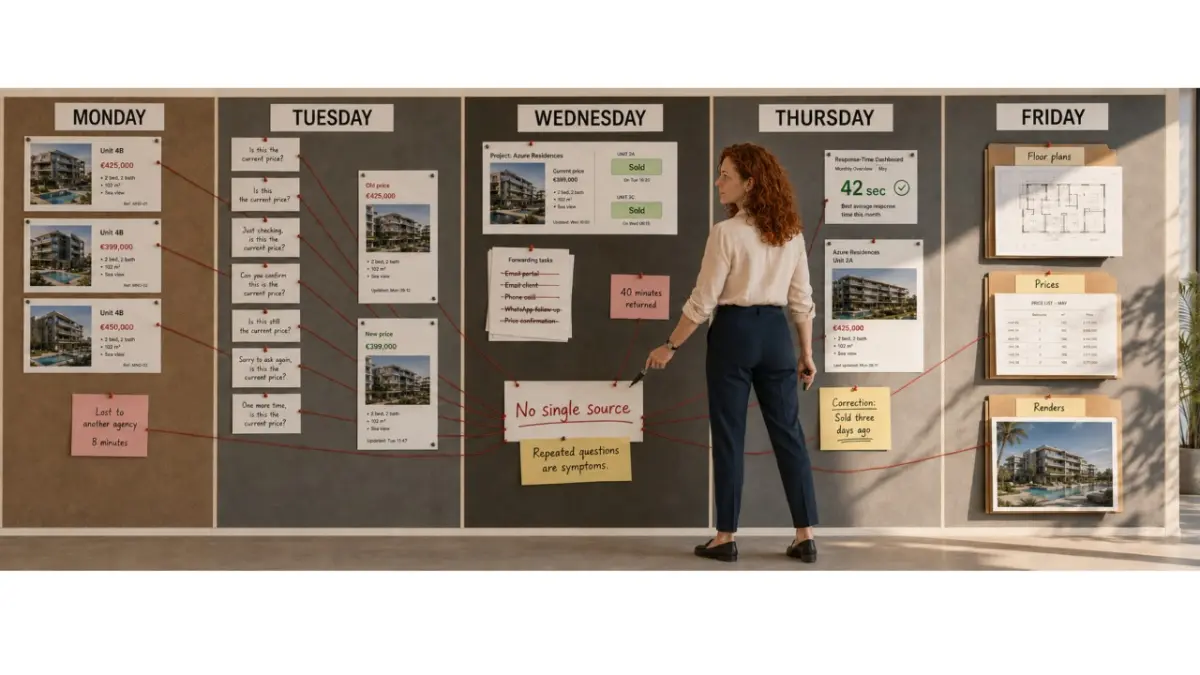
Friday morning, instead of diving straight into the chats, Marina opened the notes app on her phone and started counting.
Monday — a client who walked to another agency while she was cross-checking three files. Tuesday — six repeat versions of the same question from six different people: "Is this actually the current price?" Wednesday — forty minutes she hadn't spent forwarding files, for the first time in a long while. Thursday — forty seconds spent on a wrong answer the dashboard still logged as a win.
She'd never put these side by side before. On their own, each one looked like a minor annoyance — not worth complaining about, just the usual noise of the job. Together, they formed a pattern she recognized instantly.
A Repeat Question Isn't a Personality Trait
She used to have a simple explanation for weeks like this: clients are just picky this month, or everyone's on edge about prices right now. A convenient story — it didn't ask her to change anything, because the fault seemed to sit entirely on the other side of the conversation, with people who asked the same thing three times.
Looking at her list on Friday, she saw it differently. Nobody asked "is it still available?" over and over because they were suspicious by nature. They asked because the answer had never had one reliable place to live as the truth. Every repeat question wasn't really about the person typing it — it was a symptom of how the data around her was built.
Repeated questions aren't normal. They're a symptom.
What Changed on Wednesday — and What Didn't
Wednesday stood out in her memory on its own, not because there'd been less work that day, but because — for what felt like the first time in ages — she hadn't had to forward anything by hand. The price change had shown up on her screen the moment the developer entered it. No pinging a colleague, no waiting, no explaining.
One quiet day didn't undo the rest of the week. But it showed her what a day could look like when "is it still available?" didn't set off a chain of five chats and three files — it just got answered.
What Arrived From the Developer That Afternoon
After lunch, once the week's list was closed out, an email came in from one of the developers — materials for a new luxury project. Marina opened the attachment: three separate files. Floor plans in one, prices in another, renders in a third, with no logic to what order she was even supposed to walk a client through them in.
This was the kind of project that gets sold to people who've already seen dozens of comparable units and expect to be spoken to at that level. What she was holding, instead, looked like it had been assembled in a rush right before a deadline — three files a buyer would have to piece together in his own head.
It struck her that a luxury listing shouldn't reach a buyer as a kit he has to put together himself. If a unit is priced like a flagship, the presentation should look like someone had already thought it through on his behalf — not left him homework.
It wasn't the same problem that had followed her all week — this one wasn't about whether the numbers were current, but about the shape the numbers arrived in once they reached someone ready to buy. Still, something about it felt familiar: once again, the agent was the one gluing together, by hand, something that should have arrived already assembled.
End of the Week
Marina closed her laptop Friday evening with a feeling she hadn't had on Monday. Not because the week had been easy — it hadn't been. But because, for once, she could name exactly what had worn her out, instead of chalking it up to "just one of those weeks."
Less chasing. More selling.
She'd been hired to sell. Not to babysit PDFs. By Friday, that line had stopped sounding like a complaint about a bad Monday. It had turned into an observation, backed by five days of specific, countable evidence — not just one rough morning.
What This Story Is Really About
A client asking the same question twice isn't a reason to assume they're distrustful or slow to catch on. It's a signal that the information they're asking about has no single reliable source. Until that gets fixed at the architecture level, no amount of speed or patience from the agent makes the question go away — it just comes back, worded differently, from someone else.
The Week in Review
We spent this week with Marina — from Monday, when a lost deal cost her three cross-checked files and eight minutes of waiting, to Friday, when she lined up the week's smaller frustrations and finally saw them as one recurring pattern rather than a string of bad luck.
What the week actually shows is that the problem was never the agent's response time, and it was never a client's patience for asking things twice. It's that the information behind every answer has no single source to trust — which turns every update into a chain of manual checking, and turns every repeat question from a client into a symptom, not a complaint.
Author
This material was written by Maria Vashchenko.
For questions, collaboration, or further discussion, feel free to contact me on LinkedIn.