How Professional Property Exchange Works in an MLS
Learn how MLS networks manage property sharing, access rights, source data, API updates, and partner collaboration across Cyprus real estate.
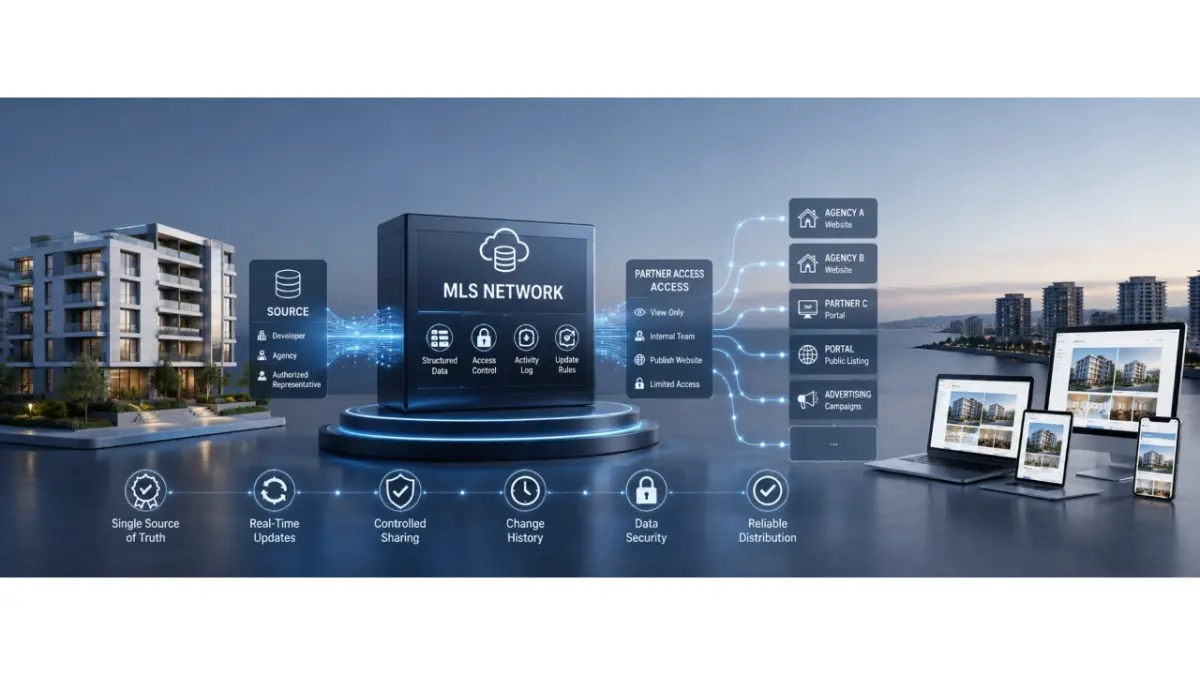
Property information is often distributed through several channels at once. An agent receives a PDF, an agency saves the listing in an internal spreadsheet, a developer sends a revised price through WhatsApp, and a property portal continues displaying the previous version. Over time, the same property exists in several forms, each containing slightly different information. A professional real estate exchange platform addresses this problem by connecting the original data source with authorised partners and external channels through one controlled process.
How an Exchange Platform Differs From a Property Portal
A public property portal helps buyers search for homes and submit enquiries. Its main purpose is to display listings to a broad audience. It may receive information manually, through an XML feed, or via an API, but it does not necessarily control the original record, partner permissions, or the complete history of changes.
An MLS or professional exchange platform operates at a different level. It organises the flow of information between market participants before a listing reaches the buyer. The system defines who created the property record, who may edit it, which partners can access it, and where the information may be published.
Simply displaying property cards does not make a service an MLS. A professional network requires structured data, controlled roles, update rules, source attribution, and a record of user activity.
How the MLS Network Layer Works
In a structured system, a property should not become a new independent copy every time another agency receives it. The original listing record is created by the party responsible for the information, such as a developer, an agency, or an authorised representative.
A real estate network platform then provides access according to predefined rules. One partner may only be allowed to view the property. Another may be authorised to publish it on an agency website. A member of the developer’s internal team may have permission to update prices and availability statuses.
All authorised participants continue working with records connected to the same source instead of maintaining separate versions.
When a price changes or a unit moves from Available to Reserved, the process should follow a clear sequence:
- the authorised source updates the listing;
- the system records who made the change and when;
- the revised information becomes visible to approved partners;
- connected websites and portals receive the update;
- the outdated version is removed from active distribution.
This structure cannot eliminate every technical delay, but it creates a clear source against which the current status and history of the property can be checked.
Controlled Sharing Instead of File Distribution
Sending a PDF or a link through a messaging app may appear to be the fastest way to share a property. The problem begins after the first update. When the developer changes the price, a new file must be sent, and every recipient must notice it, replace the previous version, and correct any existing publication.
A professional platform for property sharing manages not only the transfer of information but also the conditions under which that information may be used. A listing can be shared in several ways:
- with every approved member of a partner network;
- with selected agencies only;
- with specific employees inside one company;
- for viewing without permission to download documents;
- with confidential fields hidden;
- for publication through approved channels only;
- for a limited period;
- with access removed when the business relationship ends.
Sharing a listing through a platform does not automatically make it public. A developer may provide selected partners with access without publishing the project on a public portal. An agency may allow employees to view a listing without granting permission to redistribute its photographs or documents.
The platform retains control after access has been granted. That control is largely lost once a standalone file has been sent.
How an MLS Partner Network Should Be Managed
An open directory allows companies to place property advertisements alongside one another. A partner network MLS creates a controlled environment in which participants join under specific rules and receive defined permissions.
The network should establish:
- Who may create new listings.
- Who is responsible for prices and availability.
- Which fields partners may edit.
- Whether a listing may be shared with another participant.
- Which materials may be used for external promotion.
- How the original source is recorded.
- How duplicate records are handled.
- When a property is archived.
- How access is withdrawn after cooperation ends.
Without these rules, the network gradually becomes another uncontrolled catalogue. Participants create separate copies, rewrite descriptions, continue using old photographs, and promote properties after their status has changed.
The number of connected companies does not determine the value of the network on its own. A large database filled with duplicate listings, conflicting prices, and outdated statuses provides more volume but less certainty. Network value increases only when growth is supported by clear governance and reliable data.
Why the Original Data Source Must Remain Visible
A single property may appear on several agency websites, in paid advertising, and across public portals. That is a normal part of distribution. The problem begins when each publication starts operating independently and loses its connection to the record from which it originated.
A canonical property record preserves the identity of the listing. The system recognises that the agency website, partner-network card, and internal inventory record all refer to the same unit. When the source information changes, connected channels update their existing records instead of creating another unrelated version.
Without this connection, inconsistencies develop quickly:
- one website shows the revised price while another displays the old one;
- one agent presents the unit as Available while another shows it as Reserved;
- descriptions contain different areas, features, or completion dates;
- new photographs appear in only some channels;
- the original source becomes difficult to identify;
- buyers receive conflicting answers;
- sales teams return to manual verification.
A professional real estate exchange platform should therefore preserve data provenance as well as distribute listing information. An audit trail records who changed the listing, which fields were updated, and when the change occurred. This makes errors easier to investigate and reduces disputes between participants.
Why Standardised Data and APIs Matter
Connecting several companies technically is not enough. Their systems must interpret the information in the same way. If one platform uses a field for internal area while another combines internal space with balconies and terraces, automatic data exchange may produce incorrect results even when the API works properly.
Standardisation creates consistent fields, status values, and property identifiers. Connected systems can then understand where to find the price, how to interpret the listing status, which project the unit belongs to, and which media files are attached to it.
An API allows these updates to move between systems without requiring a new file to be sent manually. When the original record changes, a connected platform receives the update and matches it to the existing listing through its identifier.
When reviewing an integration, it is important to ask:
- whether original property identifiers are preserved;
- how quickly updates reach connected channels;
- what happens when synchronisation temporarily fails;
- whether failed updates can be identified and retried;
- whether requests and changes are logged;
- whether publication can be controlled separately for each channel;
- how data distribution stops after access is withdrawn.
An API does not guarantee accurate data by itself. It must maintain the relationship between the source record and every authorised representation of that record.
What to Check Before Joining a Platform
A real estate network platform should not be evaluated only by the number of listings it contains or the appearance of its interface. The more important question is how it manages information after several companies begin using and distributing the same records.
Before joining, clarify:
- Who owns the listing data?
- Who creates and edits the original record?
- How is the property source verified?
- Can access be restricted at project or listing level?
- Which visibility settings are available?
- Who may publish the materials through external channels?
- How does the platform detect and manage duplicates?
- Is the history of price and status changes retained?
- Can previously granted access be withdrawn?
- How is external publication stopped?
- Can data be exported when the agreement ends?
- Which partner actions appear in the audit log?
- How are lead and contact data protected?
For companies operating in Cyprus, GDPR requirements also apply where personal data is involved. Property information is not always personal data, but buyer enquiries, contact details, communication histories, and user accounts require controlled access. The transfer of this information to partners should have a clear legal basis, and user activity should be restricted according to role.
Professional Exchange Begins With Data Control
An MLS should not become another location where independent copies of listings are uploaded. Its value comes from keeping every authorised representation connected to the original source while giving partners access under defined conditions.
A structured platform for property sharing separates public marketing from professional collaboration. A partner network MLS determines who may use listing data and how. Standardised records and APIs support updates across connected channels, while audit logs provide visibility into how information is changed and distributed.
A professional network becomes useful not simply because it contains many listings. It becomes useful when participants know where the information came from, who is responsible for keeping it current, and what each partner is permitted to do with it.
FAQ
What is a real estate exchange platform?
It is a professional system for sharing and synchronising property data between authorised market participants and connected channels. Unlike a basic portal, it manages the original listing record, access rights, updates, and change history.
How is an MLS different from a public property portal?
A portal is primarily designed for buyer search and lead generation. An MLS organises professional data exchange, partner access, and listing management before information is distributed publicly.
Can an MLS be used only within one agency?
Yes. Access may be internal, partner-only, invitation-based, or public. A property does not need to be visible to the general market simply because it is stored in an MLS.
How does a platform prevent multiple versions of the same property?
It can use canonical records, unique identifiers, API synchronisation, controlled editing permissions, duplicate-detection rules, and audit logs to keep connected publications linked to one source.
How is controlled sharing different from sending a PDF?
A PDF becomes an independent copy that cannot be centrally updated or withdrawn. Platform access can be modified, restricted, or removed, while authorised users continue receiving updates from the original record.
Why does a larger listing database not always create a stronger network?
A database filled with duplicates, outdated statuses, and conflicting prices becomes harder to trust. The value of the network depends on data quality, source control, and clear participation rules, not only on listing volume.
Author
This material was written by Maria Vashchenko.
For questions, collaboration, or further discussion, feel free to contact me on LinkedIn.