The Folder That Stayed Silent
Discover why outdated folders, price lists, and PDFs slow property sales. Learn how live project data helps agents respond faster and close more deals.
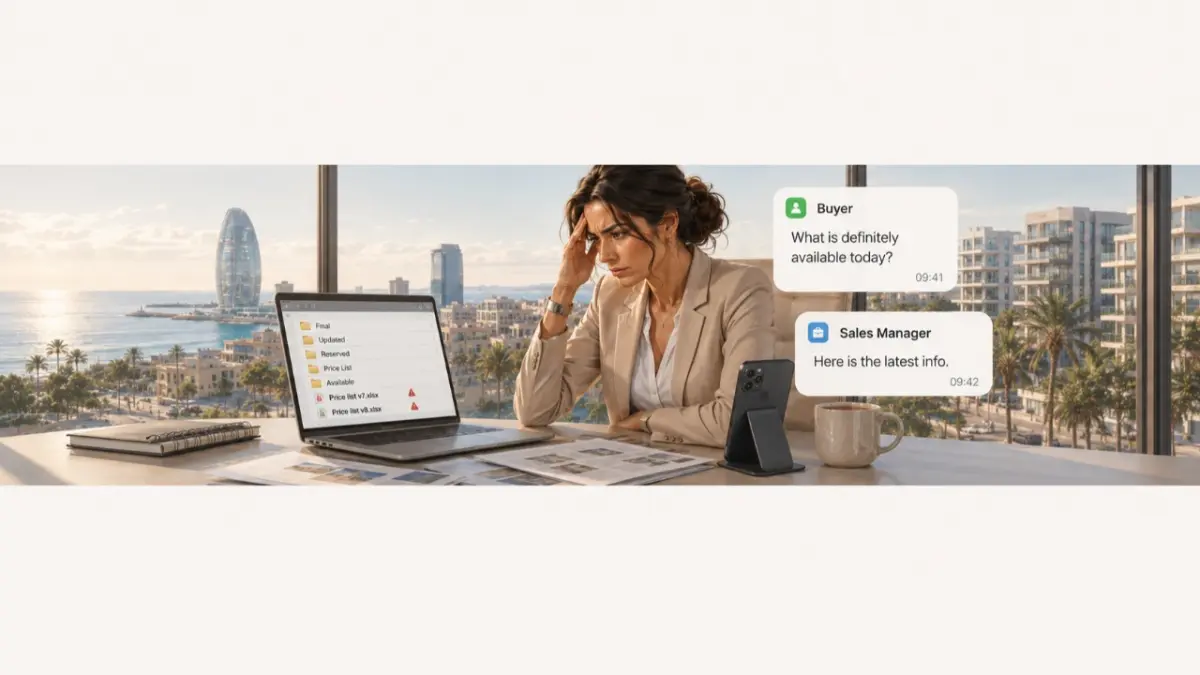
In Limassol, mornings move fast.
The coffee is still hot, the sun is already hitting the glass, and an agent’s phone is usually awake before the agent is. Three chats, two voice messages, one buyer who is not saying “maybe later,” but “let’s do it today.”
Elena Markou liked messages like that.
Not because they were easy. They were not. Messages like that leave no space for vague promises, polished brochures, or long explanations. The buyer is already in Cyprus. He has already seen a few properties. He understands the area, the budget, and the difference between “sea view” and “you can see the sea if you lean far enough over the balcony.”
At 09:17, he wrote:
“Elena, I need a two-bedroom option. Limassol or nearby. Not old stock. Current price, payment plan, and what is actually available. I want to decide today what to view tomorrow.”
Elena smiled.
This was a real buying moment. Not a cold lead. Not casual market browsing. Not “send me everything and I’ll think about it.” The buyer was already choosing.
She immediately thought of the right project. A new development, a solid developer, a strong location, clean layouts. In her head, Elena already had the answer: two units, one slightly more expensive with a better view, the other more comfortable on budget and timeline.
All she had to do was open the materials.
Elena clicked the Dropbox link.
And the office air seemed to thicken.
The folder opened confidently, almost beautifully. There was plenty inside: a presentation, renders, floor plans, a project PDF, a price table, another price table, a folder named “Updated,” another named “Final,” another named “Final 2,” and one last folder called “Please use this.”
Elena looked at the screen the way agents look at a file that has betrayed them before.
She opened the first price list. The unit she needed was available.
She opened the second one. The same unit was marked as reserved.
She opened the presentation. The delivery date was outdated.
She opened the PDF. It loaded so slowly it felt less like a property brochure and more like the entire history of the Mediterranean.
Then the buyer sent another message:
“Can you send only what is definitely available? I don’t want to waste time on sold units.”
Elena said quietly to the screen:
“Neither do I.”
But the screen stayed silent. Dropbox stayed silent. The folder stayed silent. It had everything except the answer.
Elena messaged the developer’s sales manager:
“Can you please confirm two-bedroom units in Limassol, available today? What is actually free right now?”
One minute passed. Then another. Then five.
In normal life, five minutes is nothing. In real estate sales, five minutes can become a crack. The buyer has already opened another chat. Another agent has already sent options. Another developer already looks more organised, even if the property itself is weaker.
Elena knew this too well.
She could not send an old price. She could not send a unit that was “probably available.” She could not write “I’m checking” for the third time that week. That phrase never sounds like care. It sounds like a broken workflow.
The manager replied twelve minutes later:
“Don’t use the old price list. I’ll send the new one now. One unit is sold, the second went up in price.”
Elena closed her eyes for a second.
The neat little plan in her head collapsed like wet paper. One unit disappeared. The second became more expensive. Now she had to find a replacement, check another folder, another PDF, another chat.
The buyer wrote again:
“I’ve already received an option from another agent. Send yours too.”
That was no longer an open buying moment.
That was a place in line.
Elena still prepared the selection. Carefully. Professionally. With the price, payment plan, and explanation. She sent the message, but she already knew the buyer had moved out of the hot moment.
That evening, Elena sat in her car by the sea and looked at her phone.
The buyer’s reply was short:
“Thanks. I’ll come back to it later.”
Agents know that sentence. It sounds polite. Clean. Almost harmless.
Most of the time, it means the conversation is over.
Elena opened the same Dropbox folder again. The renders were still beautiful. The presentation still looked expensive. The project was still good. The developer was still reputable. Everything looked decent.
That was what annoyed her most.
The project was not weak. Elena was not a bad agent. The buyer was not random.
But between them stood a folder.
Not a sales system. Not live inventory. Not working access for an agent. Just a folder where old versions sat beside new ones, PDFs pretended to be answers, and prices changed faster than file names.
The next day, Elena caught herself thinking something uncomfortable.
When another buyer asked for a similar property, she did not first remember the strongest project.
She remembered the one that was easiest to work with.
The one where availability was clear.
The one where the price was not hiding in an old file.
The one where she did not need to message a sales manager before giving every answer.
The one she could open and present with confidence.
That is how strong projects start losing.
Not because they are worse. Not because the location is weak. Not because agents are lazy.
They lose because they are harder to move from developer to buyer.
For a developer, it may look like agents are not active enough. For an agent, it feels like chaos in the materials. For a buyer, it looks like uncertainty in the market.
But the problem is simpler.
A folder stores.
It does not sell.
That is the gap RealtyHub MLS is built to close: to make sure a project does not sit in a digital archive, but is ready for the agent at the exact moment a buyer asks, “What is actually available today?”
Author
This material was written by Maria Vashchenko.
For questions, collaboration, or further discussion, feel free to contact me on LinkedIn.