A Practical Time Management System for Cyprus Real Estate Agents
Build a practical system for managing leads, viewings, follow-ups, property data, and daily priorities without losing flexibility or client momentum.
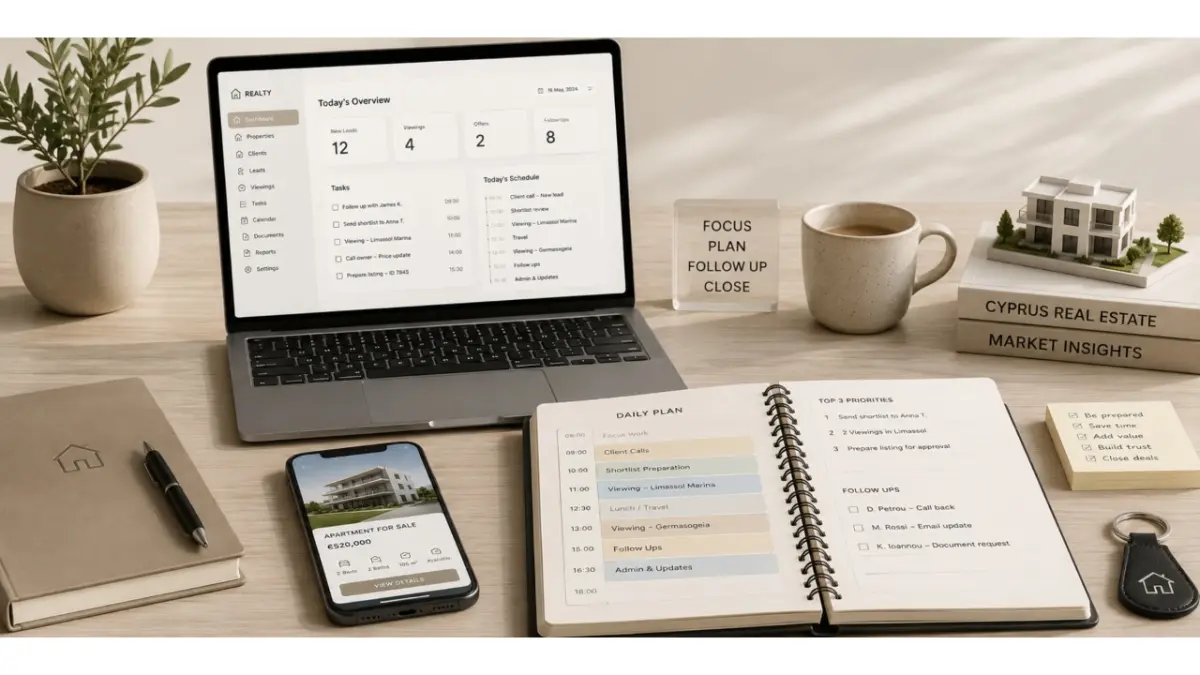
A real estate agent’s working day rarely follows a fixed sequence. A buyer may request an urgent shortlist, an owner may change the price, a viewing may move to another time, and a developer may still be confirming availability. At the same time, the agent needs to update client records, prepare documents, check new inventory, and follow up after previous meetings.
Effective time management for real estate agents cyprus is therefore not about creating a perfect timetable that survives every interruption. It is about building a working structure that protects important tasks while leaving enough flexibility for real client needs. Clear priorities, reliable property data, realistic travel planning, and specific next actions make the schedule easier to manage even when circumstances change during the day.
Productive Work Creates a Clear Next Step
Not every task contributes equally to progress. Confirming a suitable property, qualifying a serious buyer, preparing a relevant shortlist, arranging a viewing, and passing an offer to the owner can move a transaction forward directly. Administrative work remains necessary, but it should support those actions rather than occupy the whole working day in small, disconnected fragments.
An agent may appear busy while repeatedly searching for the latest price, checking several conversations for the current status, or entering the same listing into multiple systems. This creates activity without necessarily creating progress. A practical system for time management for real estate agents cyprus should make it easy to identify which tasks advance a client, property, or negotiation and which tasks need to be grouped, delegated, or simplified.
Operational Friction Consumes the Working Day
Many time-management problems begin with fragmented information rather than weak personal discipline. When property details are distributed across WhatsApp, email, PDFs, spreadsheets, and portals, the agent must rebuild the same context before every shortlist or viewing. Manual availability checks, repeated data entry, unclear responsibilities, and constant notifications add extra steps to work that should be straightforward.
The most useful response is to shorten the process between a request and a decision. Property information should have one dependable source, follow-up should have a recorded deadline, and active transactions should always have one visible next action. The fewer systems an agent needs to search before responding, the easier it becomes to estimate workload, protect focused time, and provide clients with accurate information.
Time Blocks Protect Important Tasks
Time blocking gives essential work a defined place in the calendar before it is displaced by incoming messages. The method does not require an agent to ignore urgent leads or refuse last-minute changes. It simply separates genuine urgency from work that can be handled during a scheduled communication, administration, or follow-up window.
The first part of the day may be used for new enquiries, qualified clients, active negotiations, and shortlist preparation. Viewings and meetings can occupy the central part of the day, while a later block can cover follow-up, property updates, and preparation for tomorrow. A weekly productivity schedule should also include buffers for travel, delayed appointments, access issues, and sudden changes in availability, because a calendar filled to full capacity becomes unusable after the first disruption.
Route Planning Improves the Quality of Viewings
A viewing starts well before the agent arrives at the property. The client needs to be confirmed, the owner or project representative must be contacted, the current status should be checked, and the route has to account for realistic travel and access time. Grouping appointments by area can reduce unnecessary driving and make delays easier to absorb.
Before leaving, the agent should know the address, access instructions, parking situation, responsible contact, and any documents or plans the client should receive in advance. A suitable backup property in the same area can protect the schedule when a unit becomes unavailable. After the meeting, the agent should record the client’s reaction, main concerns, preferred features, and agreed next step while the details are still clear.
A Daily Plan Keeps Priorities Visible
A useful daily planner for agents should not duplicate the entire CRM or become another database that needs constant maintenance. Its purpose is to show what matters today, connect meetings with active transactions, and make overload visible before the schedule begins to fail.
A one-page planner can include:
- Three outcomes that must be achieved by the end of the day.
- One next action for each priority client or transaction.
- New leads that require an initial response or qualification.
- Confirmed viewings with travel time and contact details.
- Follow-ups connected to meetings, offers, or documents.
- Buffer time for urgent changes and delays.
- A short end-of-day review.
For example, the three main outcomes may be sending a confirmed shortlist to one buyer, completing two viewings in the same district, and preparing a new listing for internal approval. A well-designed daily planner for agents helps the agent judge whether additional work can realistically fit into the day or whether it should be postponed, delegated, or moved into another block.
Each System Needs One Clear Purpose
Property data, client communication, meetings, tasks, and documents should not compete across several disconnected tools. An MLS or inventory platform should hold current property details, prices, statuses, and access rules. A CRM should maintain client history, deal stages, notes, and follow-up. The calendar should contain meetings and protected work blocks, while approved documents should remain in a controlled repository.
Problems appear when the same task is copied into a CRM, calendar, notebook, and several chats. The agent must then remember which version is current before taking action. A strong productivity schedule depends on one primary location for each type of information, even when connected systems display or synchronise the same data.
Technology also saves time only when the information inside it is reliable. If property statuses remain outdated, the agent still needs to contact owners, developers, or partners before every recommendation. Clear update responsibilities, consistent data standards, and regular use by the whole team matter as much as the platform itself.
Automation Supports Repetitive Work
Routine reminders, meeting confirmations, lead assignment, and basic follow-up messages may be automated when the process is clearly defined. Automation is useful when it removes repeated manual steps without hiding responsibility or replacing professional judgement. A confirmation message can request a reply, while a CRM rule can create a follow-up task after a viewing.
Delegation follows the same principle. An instruction such as “prepare the new listing” is too broad to save time reliably. The delegated task should specify which fields need checking, which documents are required, what result is expected, and when it must be ready. The agent should retain responsibility for qualification, negotiation, and important client decisions while structured operational work is completed according to an agreed standard.
Progress Matters More Than Activity
The number of calls, messages, and meetings does not show whether time was used effectively. Better indicators include the number of leads with a scheduled next action, overdue follow-ups, cancelled viewings, listings without a recent status check, and transactions with no recorded activity. Repeated manual entry and excessive administrative time may also reveal where the workflow needs to be improved.
A short review at the end of the day should establish what was completed, which transactions changed stage, and which actions move into tomorrow’s plan. This keeps the daily planner for agents connected to real developments rather than allowing it to become an expanding list of unfinished work. Activity describes how much happened; productivity shows whether those actions created meaningful movement.
A Flexible Structure Supports Consistent Performance
There is no single routine that suits every agent. Working hours depend on the market segment, team structure, location, client time zones, property type, and number of active transactions. The schedule must therefore remain adjustable without becoming completely reactive.
The core logic of time management for real estate agents cyprus remains stable: high-impact actions receive protected time, repetitive work is grouped, viewings are organised by route, follow-up is recorded immediately, and every active transaction has a defined next step. A weekly productivity schedule provides a consistent rhythm while preserving space for urgent negotiations, client changes, and unexpected availability updates.
FAQ
How detailed should a daily plan be?
A daily plan should remain short enough to review quickly. It should show the day’s main outcomes, confirmed appointments, priority transactions, next actions, and available buffer time without copying the full history stored in the CRM.
How quickly should a new lead receive a response?
A new lead should receive a timely acknowledgement and basic qualification. A complete shortlist or detailed recommendation can follow after the agent has confirmed the client’s needs and checked current property availability.
When should follow-up be completed?
Routine follow-up can be handled during planned communication windows. Active negotiations, urgent document issues, and time-sensitive property changes may require a faster response outside those blocks.
How should several viewings be organised?
Viewings should be grouped by area where possible and planned with realistic travel, access, parking, and preparation time. Each appointment should be reconfirmed before the agent leaves.
How can an MLS reduce administrative work?
An MLS can reduce repeated searches and duplicate data entry when property information is current, responsibilities are clear, and the team uses the platform as its primary inventory source.
What is the difference between activity and productivity?
Activity describes the volume of calls, messages, meetings, and tasks. Productivity reflects whether those actions created a meaningful next step for a client, property, negotiation, or transaction.
Author
This material was written by Maria Vashchenko.
For questions, collaboration, or further discussion, feel free to contact me on LinkedIn.